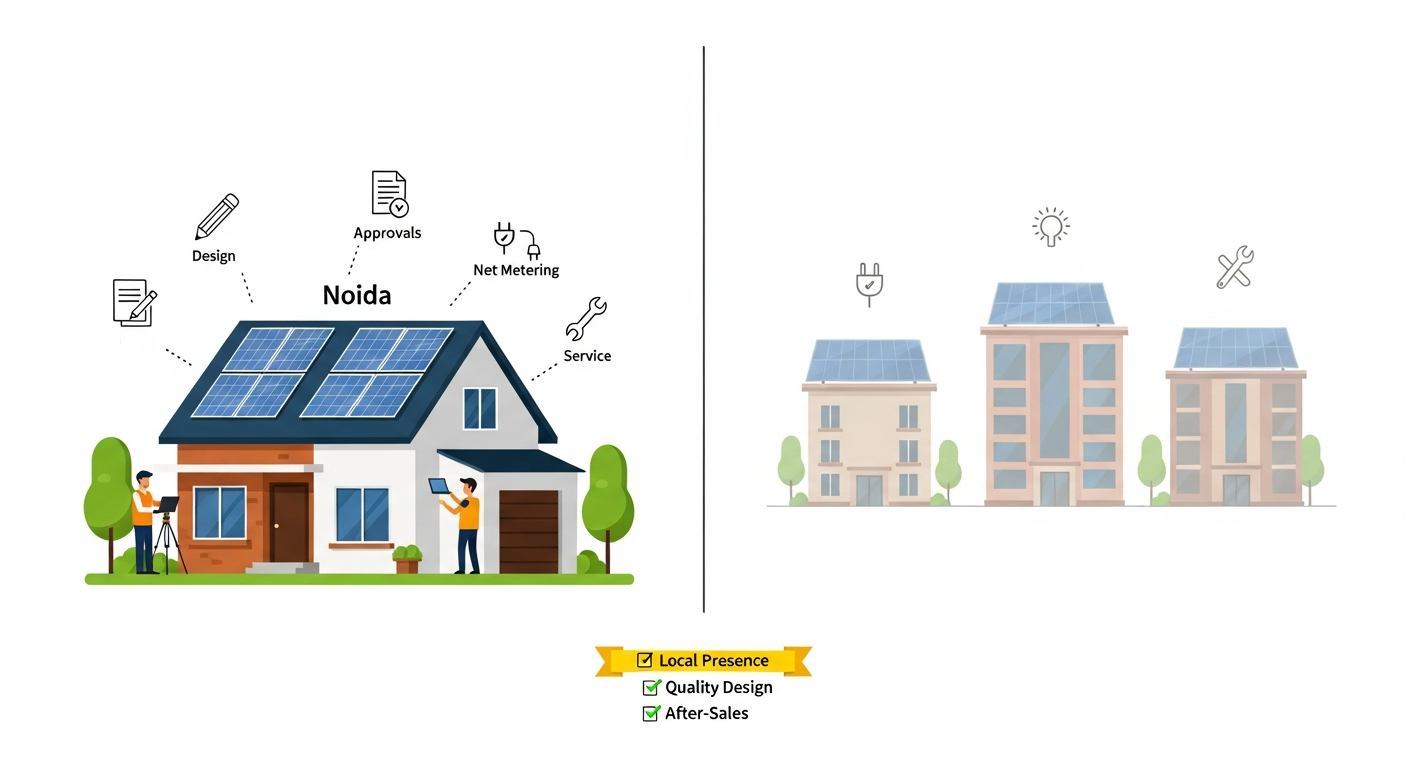
Installing a residential rooftop solar system in Uttar Pradesh in 2026 is more affordable than many homeowners think, mainly because of combined central and state subsidies. Actual project cost still depends on system size, location, components, and your installer, but you can use publicly available benchmarks and subsidy slabs to understand the overall cost structure and savings potential.
1. What Actually Makes Up Your Solar Cost?
For a typical home in Uttar Pradesh, the total project cost is not just about panels. It usually includes solar modules, inverter, mounting structures, DC/AC cabling, protection devices, installation labour, design, and approvals. Higher‑efficiency panels or premium inverters may increase upfront cost but can improve performance and long‑term reliability. Your roof type, shading conditions, and distance from the main distribution board also affect the final quotation you receive from installers.
2. Benchmark Price Range: How Much Does a System Generally Cost?
Across India, many studies and industry examples show that small residential rooftop systems are often quoted within a certain per‑kW band before subsidy, with total project amounts scaling up as capacity increases. Public guides for Uttar Pradesh in 2026 indicate that a 1–5 kW grid‑connected residential system can typically fall into a moderate investment bracket, with larger 8–10 kW systems requiring a higher, but still scalable, budget. Because each site is different, these ranges are indicative only; your actual cost will be confirmed after a detailed site survey and design from an empanelled vendor.
3. Central Subsidy Under PM Surya Ghar: Muft Bijli Yojana
In 2026, the PM Surya Ghar: Muft Bijli Yojana continues to support residential rooftop solar with central financial assistance (CFA) linked to system size. As per official communication, benchmark prices correspond to a central subsidy of ₹30,000 for a 1 kW system, ₹60,000 for 2 kW, and ₹78,000 for systems of 3 kW or higher, with eligible households also able to receive up to 300 units of free electricity per month, depending on capacity and consumption. The scheme is online and is planned to run up to FY 2026‑27, with applications and tracking handled through the national rooftop solar portal.
4. Additional State Support from Uttar Pradesh (UPNEDA)
Uttar Pradesh offers an additional state‑level subsidy that works along with the central CFA for residential consumers. Public policy summaries and industry resources mention a state incentive structure around ₹15,000 per kW with a typical upper limit of about ₹30,000 per consumer, disbursed on a reimbursement basis after successful installation, net‑metering, and documentation through UPNEDA. This stacked support further lowers the effective cost for homeowners who meet eligibility criteria and use empanelled vendors under the scheme.
5. Payback Period and Savings in Uttar Pradesh
Indian case studies show that many households recover their solar investment within a few years through reduced grid electricity bills. For typical urban homes with moderate to high monthly consumption, analyses frequently indicate an approximate payback of about 3–6 years, depending on system size, tariff rates, and how well the system is designed and maintained. After this period, most of the electricity generated is effectively at a very low marginal cost for the remaining panel life, which is commonly 20–25 years.
6. How to Estimate Your Own Cost Responsibly
Instead of relying on a single online number, start by checking your last 12 months of bills to understand your average monthly units and sanctioned load. Then, use official portals like the national rooftop solar site and the UPNEDA platform to understand current subsidy rules, empanelled vendors, and application steps, and request a site visit from at least one approved installer to get a tailored proposal. This approach keeps your expectations realistic while ensuring that your quote, subsidy, and payback estimates are grounded in official data and your actual usage.
FAQs – Residential Solar Cost in Uttar Pradesh 2026
Q1. How is residential solar cost calculated in Uttar Pradesh?
Your cost is mainly driven by system size, component quality, site conditions, and installer charges, with subsidies reducing the final amount you pay.
Q2. What subsidy can UP homeowners get on rooftop solar in 2026?
Eligible homes can combine central CFA under PM Surya Ghar with state support via UPNEDA, subject to scheme limits and vendor empanelment rules.
Q3. How long does it usually take to recover solar investment?
Many Indian households see a typical payback period of around 3–6 years, depending on their tariff, usage, and system size.
Q4. Do I need to apply separately for UP state subsidy?
State subsidy normally flows through the same portal and process, with UPNEDA handling eligibility, documentation, and reimbursement after commissioning.
Q5. Where should I start if I want solar for my home in UP?
Begin by checking the national rooftop portal, reviewing UPNEDA guidelines, and contacting an empanelled local installer for a site survey and detailed proposal.

