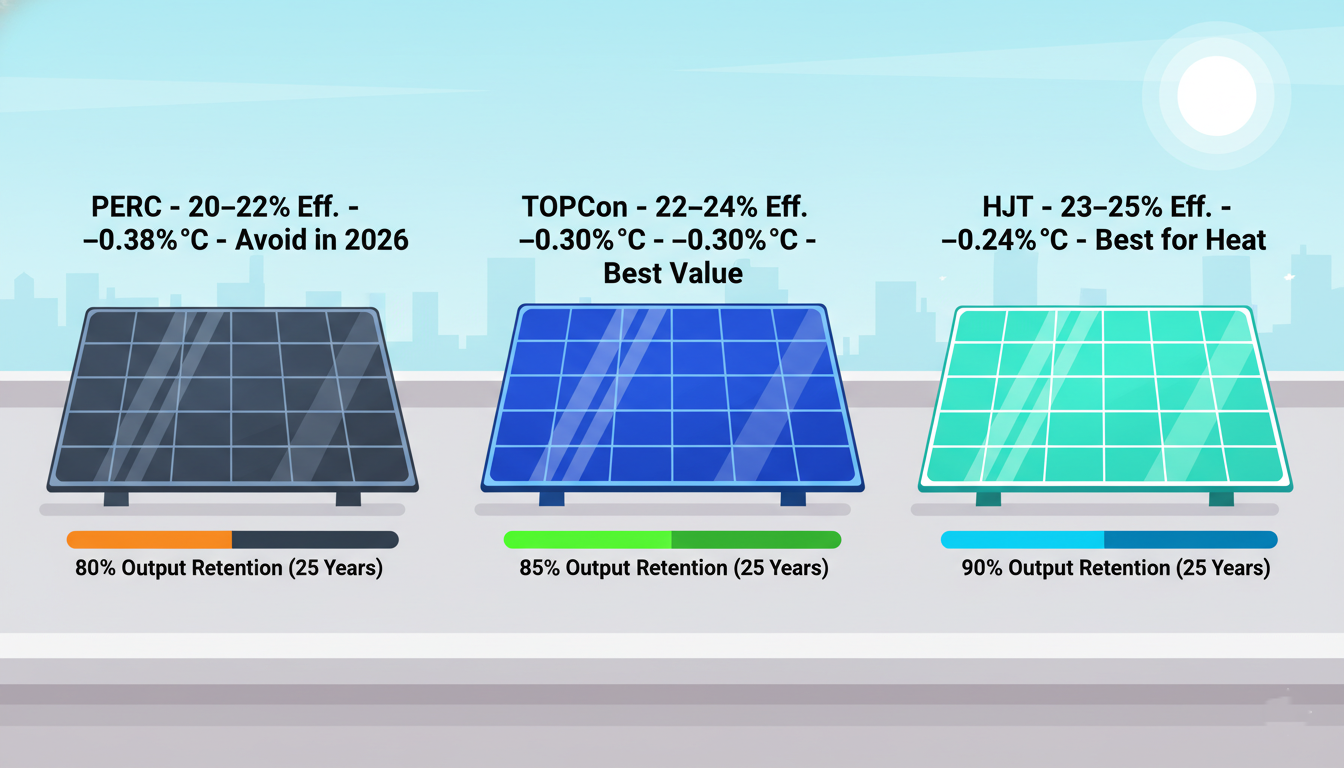
The rooftop solar panel you could have bought two years ago is already outdated. Mono PERC — the technology that dominated Indian installations through 2022–2024 — is being phased out globally in favour of N-type TOPCon and HJT panels that deliver meaningfully better efficiency, lower heat losses, and longer lifespans. For buyers in North India's harsh climate, this technology shift is not just a technical upgrade — it is a financial one.
What Went Wrong With PERC
Mono PERC (Passivated Emitter and Rear Cell) panels delivered a genuine improvement over older polycrystalline technology and remain widely installed across India. However, PERC has hit its efficiency ceiling at around 19–22% and carries a temperature coefficient of -0.34% to -0.45%/°C — meaning significant output losses during Noida's 45°C+ summers. First-year degradation on PERC panels averages around 2%, followed by 0.45% annually, leaving systems at roughly 80–82% of original output at the 25-year warranty end.
TOPCon: The Mainstream Upgrade
TOPCon (Tunnel Oxide Passivated Contact) is an evolution of PERC, adding an ultra-thin tunnel oxide layer over the rear passivation to reduce electron recombination — the main source of efficiency loss in older cells. Manufacturers can upgrade existing PERC production lines with relatively modest investment, which is why TOPCon has scaled rapidly in India with brands like Waaree, Vikram Solar, and Adani Solar now offering commercial TOPCon modules.
Key performance gains over PERC are substantial:
- Efficiency: 22–24% commercial modules (vs 19–22% for PERC), with some premium modules exceeding 26%.
- Temperature coefficient: -0.29% to -0.35%/°C (vs -0.34% to -0.45% for PERC), recovering 2–4% additional output on hot summer days.
- First-year degradation: ~1% (vs ~2% for PERC).
- 25-year output retention: 84–86% (vs 80–82% for PERC).
- Bifacial availability: Most TOPCon modules are bifacial, adding 5–15% additional rear-side generation on reflective surfaces.
For a 5 kW system installed on a Noida terrace, switching from PERC to TOPCon translates to an additional 400–600 kWh per year — roughly one month's extra generation over a 25-year system life, entirely from technology choice.
HJT: The Premium Performance Option
HJT (Heterojunction Technology) panels combine a crystalline silicon wafer with thin amorphous silicon layers on both sides, creating a fundamentally different cell structure that outperforms TOPCon on two critical parameters: efficiency and heat behaviour.
| Parameter | Mono PERC | TOPCon | HJT |
|---|---|---|---|
| Commercial efficiency | 19–22% | 22–24% | 22–25%+ |
| Temperature coefficient | -0.34 to -0.45%/°C | -0.29 to -0.35%/°C | -0.20 to -0.25%/°C |
| Lifespan | 25 years | 25–30 years | 30+ years |
| Annual degradation | ~0.45% | ~0.40% | ~0.25–0.30% |
| Relative cost | Lowest | Moderate | Premium (+20–35%) |
| 25-year output warranty | 80–82% | 84–86% | 87–92% |
HJT's temperature coefficient of -0.20 to -0.25%/°C is the best available in commercial solar — at a cell temperature of 65°C (typical for Noida in May), an HJT panel loses only 8–10% to heat compared to 18–20% for PERC. This advantage is most pronounced for rooftop installations in UP and Rajasthan, where summer heat is relentless and performance recovery translates directly into bill savings.
The limitation is cost: HJT manufacturing requires entirely new production lines separate from PERC/TOPCon equipment, keeping prices 20–35% higher than equivalent TOPCon modules in India's 2026 market.
Low-Light Performance: A Hidden Advantage in North India
One underappreciated advantage of both TOPCon and HJT over PERC is significantly better low-light and diffuse irradiance performance — relevant during North India's foggy winter mornings (November–January) when Noida and Lucknow experience weeks of reduced sunlight. TOPCon and HJT panels generate measurably more power than Mono PERC under overcast skies, recovering generation hours that older panels simply miss.
What Should Indian Buyers Choose in 2026?
The answer depends on roof space and budget:
- TOPCon is the default recommendation for most Indian residential and commercial buyers in 2026 — it delivers 10–15% better lifetime output than PERC, is now available from Indian manufacturers at a modest premium of 8–12% over PERC pricing, and qualifies fully for PM Surya Ghar subsidy under ALMM listing.
- HJT is worth the premium if you have limited roof space and need maximum power density, if you plan to keep the system for 25+ years and want the lowest degradation, or if your building is in a high-heat zone where temperature coefficient savings compound significantly.
- Avoid new PERC installations in 2026 — prices have fallen but so has long-term value; with TOPCon at near-parity pricing, there is no financial case for choosing PERC.
FAQs
Q1. Is TOPCon worth the extra cost over PERC for a home in Noida?
Yes — the additional 400–600 kWh/year from better efficiency and lower heat losses recovers the modest price premium within 2–3 years.
Q2. Are TOPCon panels available from Indian manufacturers in 2026?
Yes — Waaree, Vikram Solar, Adani Solar, and others offer ALMM-listed TOPCon modules fully eligible for PM Surya Ghar subsidies.
Q3. Does HJT perform better than TOPCon in Indian summer heat?
Yes — HJT's temperature coefficient of -0.20 to -0.25%/°C means it loses nearly half the output to heat compared to PERC, making it the best-performing technology for UP summers.
Q4. Can I still buy PERC panels in India in 2026?
Yes, but with TOPCon now available at near-parity pricing of ₹28–35/watt vs PERC at ₹22–28/watt, there is little reason to choose PERC for any new installation.
Q5. What is the lifespan of TOPCon vs HJT panels?
TOPCon panels last 25–30 years retaining 84–86% output; HJT panels last 30+ years with 87–92% output retention — both significantly outlasting PERC.

