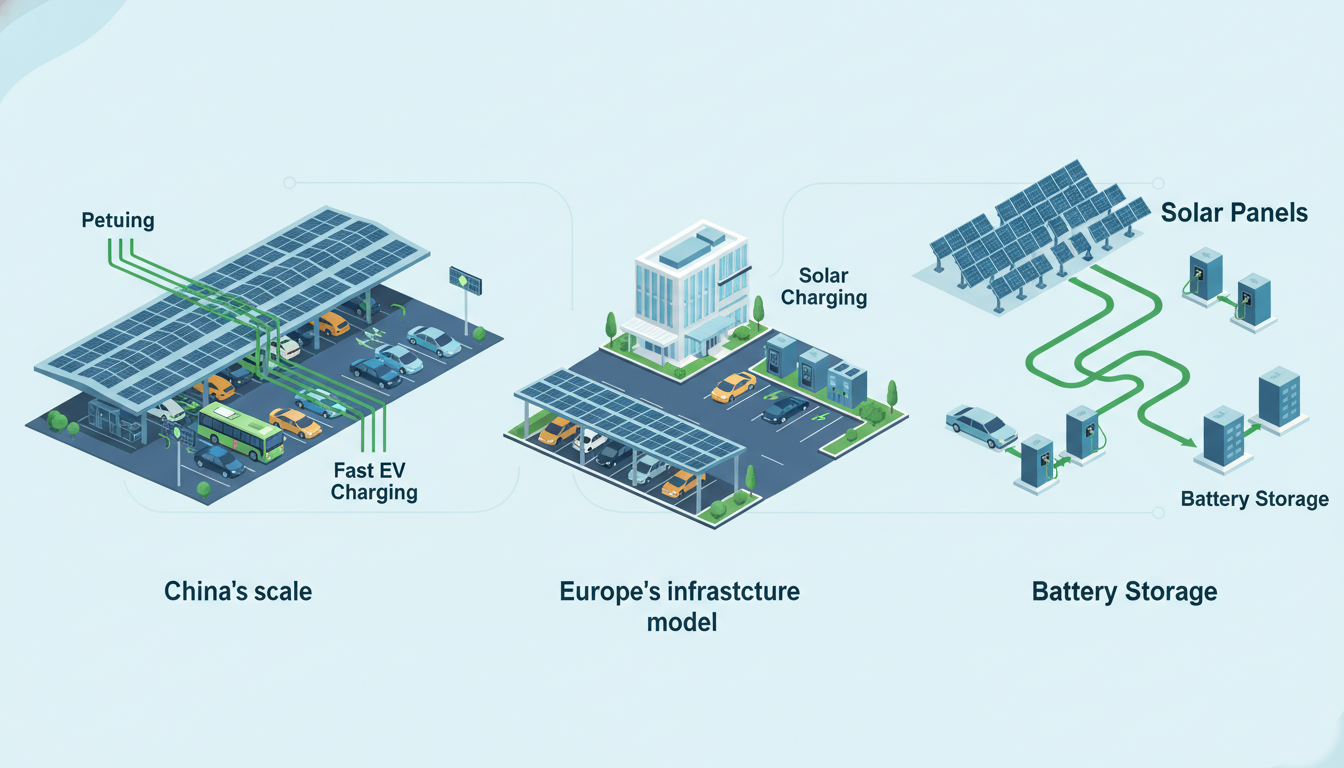
The convergence of two of the world's fastest-growing clean technologies — rooftop solar and electric vehicles — is no longer a future concept. In 2026, China and Europe are actively building charging infrastructure powered directly by solar generation, setting a blueprint that India and the rest of the world are beginning to follow.
Why Solar and EVs Are a Natural Match
An EV's biggest running cost is electricity. Charging from the grid at ₹8–9/unit in India adds up fast. Solar-generated electricity, by contrast, costs approximately ₹2.5–₹3/unit for residential systems — a 60–70% reduction in per-kilometre fuel cost when an EV is charged from rooftop solar. The match is near-perfect for daytime charging: solar generates most during the hours when home and office EVs sit parked and plugged in.
The global EV solar charging wallbox market was valued at USD 1.87 billion in 2026 and is projected to reach USD 3.75 billion by 2030, growing at a 19% CAGR, driven primarily by policy mandates in China and Europe that now require new charging stations to incorporate a proportion of clean energy or battery storage.
China: The World's Largest Solar EV Charging Rollout
China is executing the most aggressive solar-EV integration programme anywhere on the planet. Cities including Shanghai, Shenzhen, and Beijing are constructing large-scale charging hubs powered exclusively by renewable sources, with pilot projects already operational and generating measurable results.The national government provides investment subsidies for photovoltaic energy storage charging projects, while a peak-valley electricity pricing system incentivises storing cheap solar energy and discharging during expensive peak windows.
BYD, China's dominant EV manufacturer, is rolling out ultra-fast charging stations capable of adding hundreds of kilometres of range in minutes, with renewable-sourced electricity feeding these megawatt-level chargers across Chinese urban centres.The government has set a target for over 100,000 high-speed EV chargers to be installed in cities across the country by 2027, requiring proportional solar-integrated charging infrastructure to avoid placing crushing new loads on coal-dependent grid sections.
Europe: Policy-Mandated Solar Charging Infrastructure
Europe is approaching solar EV integration through regulatory rather than subsidy-first mechanisms. The European Commission's Alternative Fuels Infrastructure Regulation (AFIR) sets binding requirements for member states to deploy solar-integrated charging along major transport corridors.Carbon Emission Trading Scheme credits and Green Electricity Certificate revenues provide additional financial incentives that make solar EV charging commercially attractive for operators beyond just energy savings.
Germany, France, and the Netherlands are leading deployment of solar carport charging stations — covered parking structures with solar panels on the canopy roof, generating power that feeds both the building and parked EVs simultaneously.These structures add no additional land footprint, generate electricity, provide shade, and charge vehicles — making them highly efficient use of commercial real estate.
The Technology Behind Solar EV Charging
Three configurations dominate solar EV deployments globally in 2026:
- Direct solar-to-EV charging: DC power from solar panels feeds directly into the EV's battery through a compatible DC charger, bypassing AC conversion losses — the most efficient route but requiring compatible vehicle and charger standards.
- Solar + battery storage + EV charging: Solar charges a stationary battery bank during peak generation; the battery then dispatches power to EV chargers on demand, evening, or during grid outages — the most flexible and grid-independent solution.
- Rooftop solar + grid-tied EV charger: Solar offsets grid electricity consumption, and the EV charger draws from whichever source is cheapest at any moment — the most common and affordable setup for homes and offices today.
Integrated AI energy management systems optimise across all three configurations, automatically scheduling EV charging when solar surplus is highest and pausing when a cloud reduces generation — recovering 10–20% additional free charging compared to unmanaged systems.
What This Means for Indian EV and Solar Owners
India's solar-EV convergence is accelerating rapidly. The Bureau of Energy Efficiency's "Green Charging" initiative mandates that 25% of new public chargers by 2026 source at least half their power from renewables, while MNRE has set aside $120 million under the National Solar Mission for solar EV charging by 2027 with up to 50% capital subsidy.Adani Green Energy and ChargeZone have already announced 1,000 solar-powered chargers along the Delhi–Mumbai Expressway.
For homeowners in Noida or Lucknow who own both a rooftop solar system and an EV, the maths are compelling: a 5 kW solar system generating 600 kWh/month can provide approximately 3,000 km of free EV driving per month at an average 5 km/kWh efficiency — covering most household commuting needs entirely from sunlight. Solar-integrated EV charging also changes the financial case for rooftop solar upgrades: the addition of an EV adds 150–300 kWh/month of new consumption that solar can offset, improving system utilisation and payback period simultaneously.
FAQs
Q1. Can I charge my EV directly from my rooftop solar panels in India?
Yes — a solar system paired with a compatible EV charger can offset or fully cover EV charging costs at approximately ₹2.5–₹3/unit vs ₹8–9/unit from the grid.
Q2. How much driving range can a 5 kW rooftop solar system provide monthly?
Approximately 2,500–3,000 km per month, assuming 5 km/kWh EV efficiency and 600 kWh monthly solar generation in North India's sunlight conditions.
Q3. What is China doing differently in solar EV charging compared to the rest of the world?
China is building exclusive renewable-powered charging hubs in major cities, targeting 100,000+ high-speed chargers by 2027, and mandating solar integration in all new charging infrastructure with direct government investment subsidies.
Q4. Do I need a battery storage system to charge my EV from solar at night?
Yes — without battery storage, solar EV charging only works during daylight hours; a hybrid system with a battery bank enables overnight charging from stored solar energy.
Q5. Will adding an EV improve my rooftop solar system's payback period?
Yes — EVs add 150–300 kWh/month of high-value load that solar offsets at ₹8–9/unit grid rates, improving system utilisation and shortening payback compared to solar for household loads alone.

