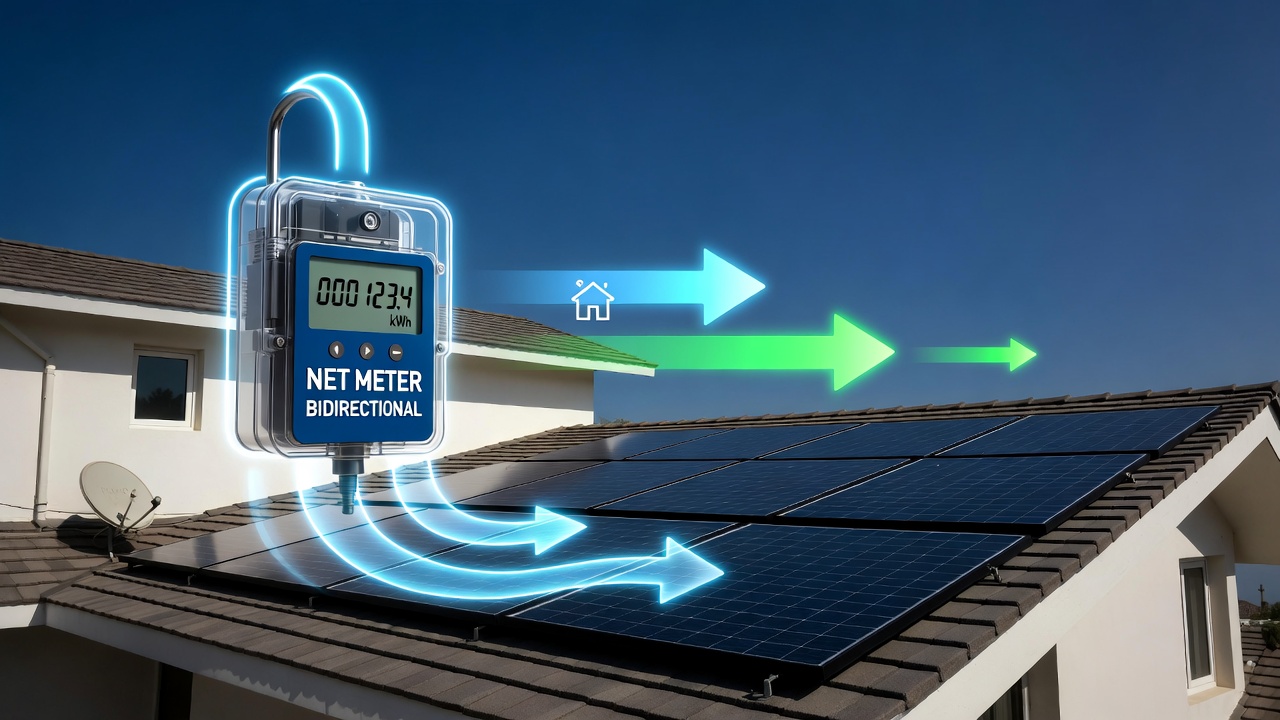
Net metering in Uttar Pradesh allows homeowners and businesses with rooftop solar to export surplus electricity back to the grid and receive credits that offset their future consumption, turning your solar system into a financial asset that works 24/7. Understanding how UP's net metering policy works, billing cycles, and credit settlement ensures you maximize savings and ROI from your solar investment.
What Is Net Metering and How Does It Work in UP?
Net metering is a billing arrangement where your rooftop solar system connects to the DISCOM grid through a bidirectional meter that tracks both the electricity you import from the grid (when solar isn't generating, like at night) and the surplus solar power you export back to the grid during the day when generation exceeds your consumption. You are charged only for the net difference between import and export, meaning if you export 600 units and import 1,000 units in a month, you pay only for 400 units.
This system allows UP homeowners to use the grid as a virtual battery—exporting daytime surplus and drawing power when needed—without investing in expensive physical batteries.
UP Net Metering Policy Framework and Eligibility
Uttar Pradesh's net metering regulations are governed by the Uttar Pradesh Electricity Regulatory Commission (UPERC), which sets the framework for grid-connected rooftop solar up to 2 MW capacity. Under the policy, residential consumers can install systems up to their sanctioned load and opt for net metering, with technical feasibility assessed by the local DISCOM within 7 days of application.
The policy targets 22,000 MW of solar power by 2026–27, including 1,500 MW from residential rooftops and 3,000 MW from non-residential rooftops, demonstrating strong state commitment to distributed solar generation. All rooftop systems under PM Surya Ghar and state subsidy schemes in UP must be grid-connected with net metering to qualify for financial assistance.
How Credits Are Calculated and Carried Forward
When your solar system generates more power than you consume in a billing cycle, the excess units are exported to the grid and recorded by your bidirectional net meter. These exported units are credited to your account and carried forward to the next billing cycle, offsetting future import charges. For example, if you export 100 units more than you import in July, those 100 units roll over to August's bill and reduce your charges for that month.
This monthly carry-forward continues throughout the year, allowing you to bank surplus generation from high-production months (like summer) against higher consumption months (like winter when heating or cooling needs may differ).
Annual Settlement Period and Payment for Excess Generation
Net metering in Uttar Pradesh operates on a yearly settlement cycle, meaning credits accumulated over 12 months are reconciled at the end of the settlement period. If at the end of the year you still have unadjusted export surplus—meaning you generated more than you consumed over the entire 12 months—the DISCOM compensates you for those excess units at a predetermined tariff rate.
Current policy provisions indicate that unused electricity credits at the end of the settlement period or when a consumer leaves the system are paid at ₹2 per kWh by the Distribution Licensee, or as notified by the UPERC from time to time. This ensures you receive financial value for every unit generated, even if you cannot consume it yourself within the annual cycle.
Net Metering Installation and Agreement Process in UP
The installation and approval process for net metering in Uttar Pradesh follows a structured timeline defined by policy. After submitting your application through the PM Surya Ghar portal or directly to your DISCOM, the utility conducts site verification and technical feasibility within 7 days. Once feasibility is approved, your empanelled vendor installs the solar system within 90 days, followed by testing of the solar plant and net meter by the DISCOM within 7 days of meter deposit.
The net metering agreement is executed within 3 days of submission of the draft agreement, and commissioning or connection happens within 3 days after the agreement is signed, with a joint commissioning report issued within 1 day. This streamlined process ensures that from application to live net-metered system, homeowners can expect completion within approximately 3–4 months under normal conditions.
Connection Levels and Capacity Limits
UP's net metering regulations specify connection levels based on system size and consumer load. Systems up to 5 kW connect via single-phase at 230V, while systems from 5 kW up to 50 kW or 63 kVA use three-phase, four-wire connections at 415V. Larger systems from 50 kW to 1 MW connect at 11 kV, and installations from 1 MW up to 2 MW connect at 33 kV three-phase, accommodating both residential and large commercial or industrial rooftops.
The maximum cumulative capacity allowed on a local distribution transformer is typically capped at 15 percent of transformer capacity to ensure grid stability and prevent overloading, which means DISCOMs may limit new net-metered connections in areas where transformer capacity is already constrained.
Metering Standards and Consumer Responsibilities
All net meters in UP must comply with Central Electricity Authority (CEA) Installation and Operation of Meters Regulations, 2006, and be of the same or better accuracy class than the existing consumer meter. The appropriate bidirectional meter is procured, installed, and maintained by the DISCOM at the cost of the consumer, though consumers can procure and present their own meters to the DISCOM for testing and installation if they prefer.
For systems above 50 kW, installation of check meters (generation meters) is mandatory at the consumer's cost to separately track solar generation, while for smaller systems up to 50 kW, check meters are optional and can be installed at the request of either party. Application fees for net metering in UP are modest—typically ₹250 for systems up to 50 kW—making the process accessible for residential users.
Benefits of Net Metering for UP Homeowners
Net metering transforms your solar investment by ensuring no generated unit goes to waste, maximizing financial returns by crediting every export unit against future bills. You eliminate or dramatically reduce electricity bills, often achieving near-zero grid import over a year for properly sized systems. The arrangement also provides grid stability benefits, as distributed rooftop generation reduces transmission losses and peak demand stress on DISCOMs, qualifying your contribution toward the utility's Renewable Purchase Obligation (RPO) compliance.
Finally, net metering is a prerequisite for accessing PM Surya Ghar subsidies and state financial assistance in UP, making it not just financially smart but mandatory for subsidy-linked installations.
FAQs
Q1. How does net metering billing work in Uttar Pradesh?
A1. You pay only for the net difference between electricity imported from the grid and surplus solar power exported; excess credits carry forward monthly within a yearly settlement cycle.
Q2. What happens to my extra solar units at year-end?
A2. Unadjusted export surplus at the end of the annual settlement period is compensated by the DISCOM at ₹2 per kWh or rates notified by UPERC.
Q3. How long does net metering approval take in UP?
A3. DISCOM completes technical feasibility within 7 days, and the entire process from application to commissioning typically takes 3–4 months.
Q4. What is the maximum rooftop solar capacity allowed under net metering in UP?
A4. Residential and commercial consumers can install systems up to 2 MW capacity under UP's net metering regulations.
Q5. Is net metering mandatory for getting solar subsidy in Uttar Pradesh?
A5. Yes, PM Surya Ghar central subsidies and UPNEDA state support require grid-connected systems with net metering arrangements.

