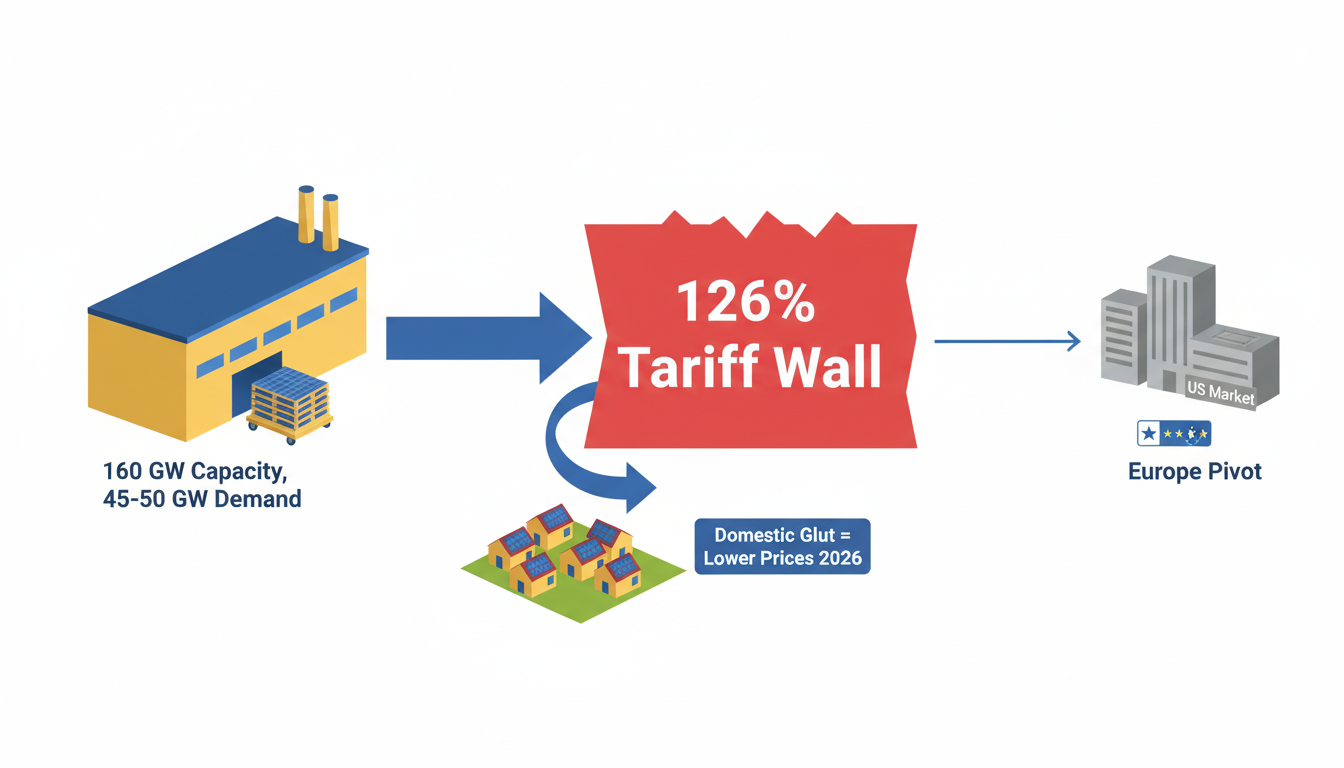
The US solar tariff story of 2026 is directly relevant to Indian rooftop solar buyers, not just exporters—because the flood of panels diverted from American markets is now pushing domestic Indian prices down, making this one of the best times in years to buy a solar system in India.
What Happened: The 126% US Tariff on Indian Solar
On February 24, 2026, the Trump administration's US Department of Commerce imposed preliminary countervailing duties of 126% on solar cells and modules imported from India, citing India's government subsidy programs as providing an unfair pricing advantage to Indian manufacturers. The move followed petitions filed by US solar manufacturers who argued that Chinese-owned factories in India, Southeast Asia, and other regions were flooding the US market with subsidised products.
The scale of the trade action reflects how dramatically Indian solar exports to the US had grown—from $83.86 million in 2022 to an anticipated $792.65 million in 2024, a nearly 10-fold rise in just two years. India, Indonesia, and Laos together accounted for 57% of US solar module imports in the first half of 2025, making them the primary targets of the action. Notably, the 126% rate was partly elevated because Adani Group's Mundra Solar declined to participate in the US subsidy investigation, triggering a punitive default duty rate.
The Overcapacity Equation: What It Means for Indian Buyers
Here is the critical chain of events that affects you as a domestic Indian solar buyer:
- India's solar manufacturing capacity has grown 13-fold since 2020, reaching approximately 160 GW annually.
- Domestic demand in India is only 45–50 GW per year, meaning overcapacity already existed before the US tariff.
- With US exports now commercially unviable at 126% duties, that excess production—previously destined for America—has no alternative market at the same premium.
- The result is intensified price competition in India's domestic market, pushing module prices down further.
Analysts confirm this directly: Elara Capital's Rupesh Sankhe stated, "As a result of overcapacity in modules, we are going to see pressure on prices." For rooftop solar buyers in Noida, Lucknow, or Kanpur, this translates into potentially lower per-watt panel costs through 2026 as manufacturers compete aggressively for domestic orders.
How Indian Panel Prices Are Being Reshuffled
Indian TOPCon solar modules were being sold to US customers at around USD 0.30/Wp compared to only USD 0.17–0.19/Wp in the domestic market. With the US market effectively closed, manufacturers face pressure to redirect volume domestically at competitive pricing, keeping Indian retail module prices soft.
Indian solar manufacturers like Waaree Energies and Premier Energies, which had exported over 50% of their production to the US in FY24, are now pivoting strategies—Waaree is expanding US-based manufacturing capacity from 2.6 GW to 4.2 GW to avoid tariffs, while Premier Energies is exploring European markets as an alternative. This pivot reduces the domestic supply pressure slightly over time, but the near-term glut in India remains intact through 2026.
Impact on the Global Solar Supply Chain
The US tariffs have also triggered broader global reshuffling that India must navigate:
- Europe opportunity: With rising anti-China sentiment in Europe, Indian manufacturers see an opening to redirect quality exports there, potentially tightening domestic Indian supply over the medium term.
- Southeast Asia diversion: Panels from Vietnam, Malaysia, and Cambodia—also hit by US anti-dumping duties of up to 271%—may seek Indian and South Asian markets, adding another layer of price competition.
- US domestic supply tightening: Reduced Indian imports may slow US solar project timelines, raising module prices there—but this does not directly affect Indian domestic prices.
- Vertical integration push: India's June 2026 mandate requiring all modules to use locally made cells adds manufacturing cost pressure that could partially offset price benefits from overcapacity.
What This Means for North India Rooftop Solar Buyers in 2026
The practical implications for a homeowner in Noida, Lucknow, or Agra considering rooftop solar right now are significant:
- Buyer's market conditions: Domestic overcapacity and export diversion are creating a genuinely competitive pricing environment—get multiple quotes from UPNEDA-empanelled vendors and negotiate on module pricing.
- Quality caution: Price pressure may tempt some distributors to move older or lower-tier inventory; insist on ALMM-listed (Approved List of Models and Manufacturers) panels to remain subsidy-eligible.
- Lock in prices now: The domestic glut is a 2026 phenomenon—as manufacturers shift to Europe, build US capacity, and June's domestic cell mandate adds cost, prices may stabilise or rise in 2027.
- PM Surya Ghar subsidy unaffected: The 126% US tariff has zero impact on India's domestic subsidy programs—PM Surya Ghar and UPNEDA subsidies remain fully available for residential installations.
Indian Manufacturers' Response at a Glance
| Company | US Exposure | Response Strategy |
|---|---|---|
| Waaree Energies | High (major US exporter) | Expanding US manufacturing to 4.2 GW; Oman polysilicon plant |
| Premier Energies | High (50%+ exports to US) | Diversifying to Europe; monitoring emerging markets |
| Adani Solar (Mundra) | Very high (default 126% rate) | Under review; 126% applied for non-participation |
| Vikram Solar | Moderate | Exploring Europe; domestic focus |
FAQs
Q1. Why did the US impose 126% tariffs on Indian solar panels?
The US Commerce Department found that Indian government subsidies gave manufacturers an unfair pricing advantage, violating countervailing duty rules; Adani's non-participation in the probe further elevated the rate to 126%.
Q2. Will solar panels become cheaper in India because of the US tariffs?
In the near term, yes—diverted export supply is intensifying domestic price competition in an already overcapacity market, applying downward pressure on Indian retail module prices through 2026.
Q3. Are PM Surya Ghar subsidies affected by US tariffs?
No, the US tariff action has no bearing on India's domestic PM Surya Ghar subsidy program; all central and state subsidies remain unchanged for residential buyers.
Q4. Should I buy solar panels now or wait?
Buying in 2026 takes advantage of current domestic oversupply pricing; waiting into 2027 risks higher prices as manufacturers pivot to exports and domestic cell mandates add production costs.
Q5. Are these US tariffs final?
The 126% duties are preliminary; a final determination later in 2026 will confirm or adjust the rate, but analysts expect the US market to remain largely inaccessible for direct Indian exports regardless of minor rate adjustments.

