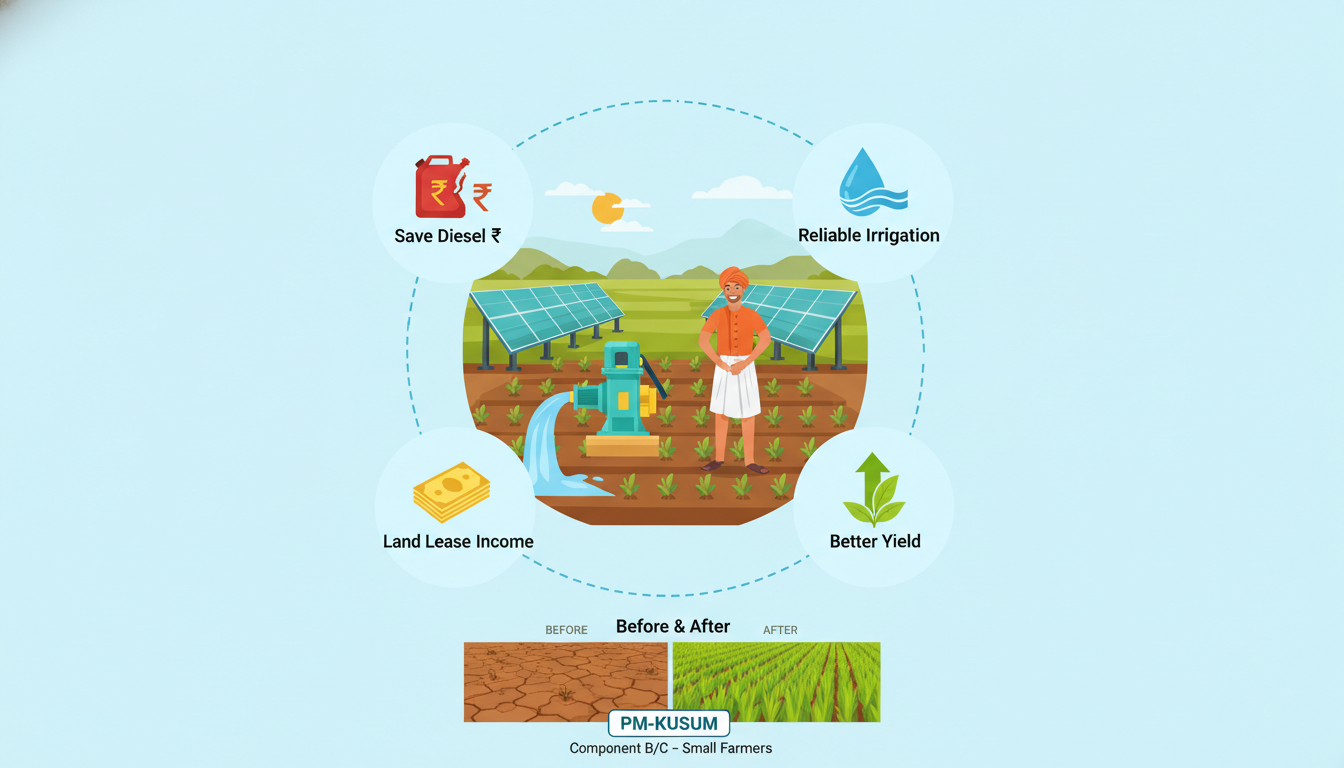
Solar water pumps are changing the economics of farming in India by cutting diesel costs, reducing irrigation uncertainty, and creating an additional income stream in some PM-KUSUM models. For small farmers, the biggest shift is simple: water becomes cheaper and more reliable, and that directly improves crop yield, farm planning, and net income. PM-KUSUM is the central policy vehicle behind this shift, with components designed for solar pumps, solarised agricultural feeders, and farmer-owned solar plants.
Why Solar Pumps Matter
India's PM-KUSUM scheme was launched to improve energy and water security for farmers, reduce diesel dependence, and support higher farm incomes through solar-powered irrigation. The scheme's official design includes standalone solar pumps, feeder-level solarisation, and decentralized solar plants, and MNRE's program documents explicitly link it to cheaper, more reliable irrigation and income enhancement.
Solar pumps also reduce the day-to-day cost of irrigation because sunlight is free once the system is installed. That means less money spent on diesel or electricity and more predictable irrigation during critical crop stages.
How PM-KUSUM Works
PM-KUSUM has three main components: Component A installs decentralized grid-connected solar plants on land; Component B installs standalone solar pumps; and Component C solarises existing grid-connected pumps, including feeder-level solarisation.
For small farmers, Component B and Component C are the most relevant because they directly reduce pumping costs. Component A can also create land-leasing income where farmers provide land for solar plants, and government statements say farmers can earn up to ₹80,000 per hectare per year under this component.
Income Impact For Farmers
The income benefit comes from three sources: lower irrigation cost, better crop productivity, and extra earnings from solar power or land leasing. Government replies in Parliament have noted that farmers under PM-KUSUM can earn from land leasing, with reported income of up to ₹80,000 per hectare per year under Component A and around ₹25,000 per acre per year in some Component C land-leasing arrangements.
A major benefit is that farmers no longer need to burn money on diesel for every irrigation cycle. Official program material says the scheme is intended to lower irrigation costs, provide day-time reliable power, and help farmers improve productivity and income stability.
Why Small Farmers Need It Most
Small and marginal farmers are the most affected by fuel prices and power shortages, but they are also the least able to invest upfront. MNRE and SBI program materials show that even with subsidies, farmers still need to contribute part of the cost, and that financing structures are a major part of the scheme's rollout.
That is why the real value of solar pumps is not just technical efficiency — it is financial stability. A farmer with predictable irrigation can plan cropping more confidently, reduce losses from delayed watering, and avoid expensive diesel runs in peak season.
The Current Challenge
PM-KUSUM has strong policy goals, but implementation has been uneven. MNRE's scheme structure and banking guidance show that Component B and C still require meaningful beneficiary contribution, and several implementation guides note that upfront payment and credit access remain major barriers for small farmers.
Another challenge is that many small farmers operate below the 3 HP threshold, while the scheme has historically focused more on pumps of 3 HP and above. As a result, adoption is slower where farmers lack access to formal finance or where smaller pumps dominate local irrigation needs.
What Makes Solar Pumps a Better Long-Term Bet
Despite the adoption hurdles, solar pumps remain one of the strongest long-term investments for irrigation in India. PM-KUSUM's design explicitly aims to reduce diesel dependence, improve irrigation reliability, and enhance farm incomes through lower recurring energy costs and, in some models, additional revenue.
For small farmers, the biggest win is not just saving money — it is improving the reliability of the farm itself. Better irrigation timing can lead to healthier crops, more stable yields, and more predictable income over time.
FAQs
Q1. How do solar water pumps increase farmer income?
They reduce irrigation cost, improve crop reliability, and can generate extra income through land leasing or surplus power sale.
Q2. What is the main purpose of PM-KUSUM?
PM-KUSUM aims to provide energy and water security for farmers while reducing diesel dependence and increasing income.
Q3. Which PM-KUSUM component is best for small farmers?
Components B and C are usually the most useful because they directly lower irrigation costs.
Q4. Why is adoption still slow for small farmers?
Upfront cost and credit access remain major barriers even after subsidy support.
Q5. Can farmers earn money from solar plants under PM-KUSUM?
Yes, farmers can earn by leasing land for solar plants under Component A.

