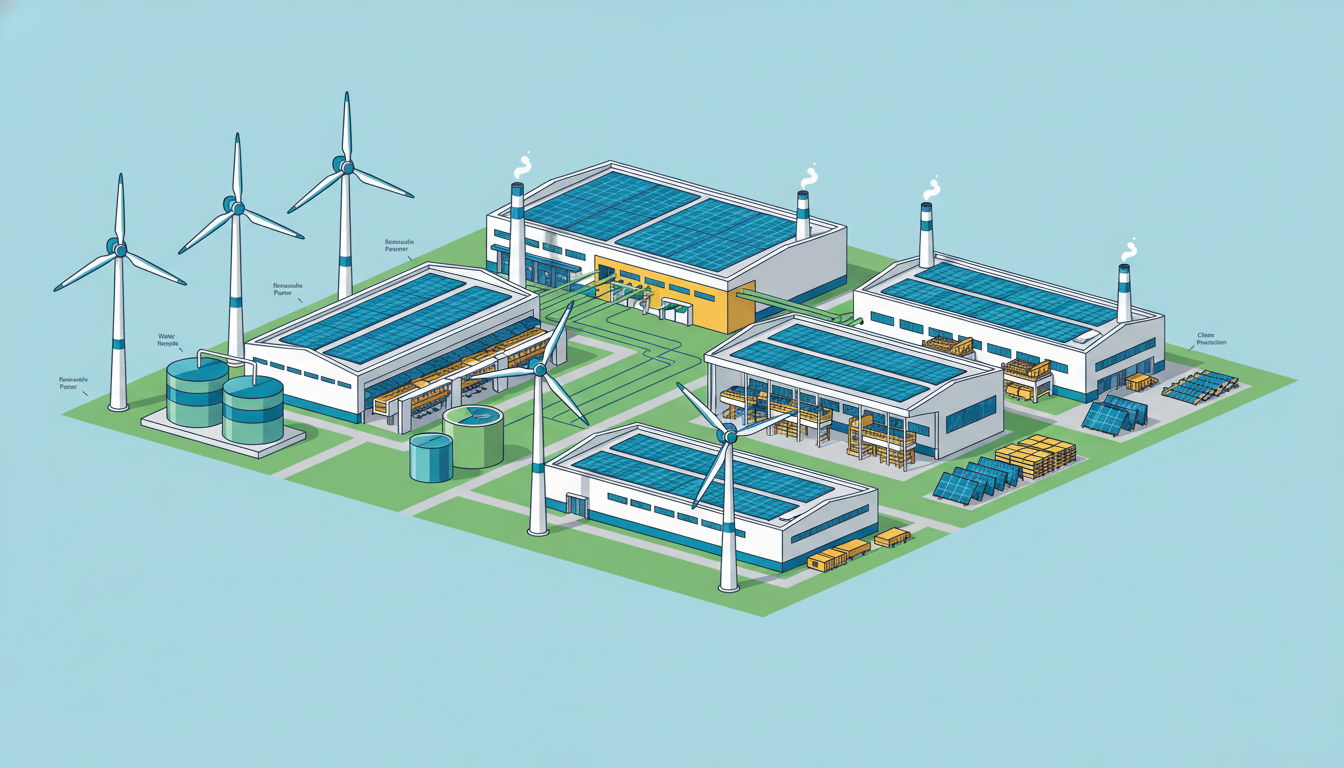
There is an uncomfortable irony at the heart of solar energy: the panels that generate clean electricity are themselves manufactured using energy-intensive processes that have historically relied on coal-heavy grids in China. In 2026, the world's largest solar manufacturers are actively dismantling that contradiction — making the production of solar panels as clean as the power they generate.
The Carbon Cost of Making Solar Panels
Solar panels have always had a carbon payback period — the time it takes for a panel to generate as much clean electricity as was consumed making it. For early polycrystalline panels, this was 3–4 years. Modern monocrystalline and TOPCon panels have reduced this to 12–18 months through efficiency gains and cleaner manufacturing. A landmark study published in Nature Communications in February 2026 found that decarbonising global electricity mixes used in panel manufacturing could save up to 8.2 gigatonnes of equivalent CO₂ emissions — approximately 6.3% of the total remaining carbon budget to limit warming to 1.5°C.
The study also found that solar panels installed by 2035 could avoid at least 25 gigatonnes of CO₂ emissions compared to conventional power sources in less than half of their operational life, reinforcing the urgency of greening the manufacturing process itself.
How Leading Manufacturers Are Cleaning Up Production
The world's top manufacturers are taking distinct, measurable steps toward green production:
- LONGi Solar (China): The world's largest solar manufacturer has committed to 100% renewable energy across its manufacturing operations by 2028, and is already running key facilities on wind and hydro power.
- Trina Solar: Between 2020 and 2022, Trina reduced GHG emissions intensity of its cell products by 50.81% and module products by 61.88% — among the fastest decarbonisation rates in heavy manufacturing globally.
- JinkoSolar: All operational manufacturing bases have achieved ISO 14001 environmental management certification, and the company has delivered over 260 GW of renewable energy worldwide while integrating CDP supply chain emissions reduction programmes.
- Tongwei Solar (China): Its 54 solar farms in China have cumulatively offset 3.3 million tonnes of carbon emissions, while portions of its own manufacturing draw power from the electricity generated by its solar parks.
- JA Solar: Six of its manufacturing bases were recognised as "green factories" by China's Ministry of Industry and Information Technology, with 99 environmental training sessions conducted in a single year covering waste treatment and emissions management.
Three Pillars of Sustainable Solar Manufacturing in 2026
The industry's green transformation is organised around three primary focus areas:
1. Renewable-Powered Factories
Leading manufacturers are powering their own production lines with solar and wind, closing the sustainability loop — the electricity used to make panels comes from panels. Research confirms that the composition of the electricity mix used to manufacture solar panels strongly affects the environmental impact of production, making renewable-powered factories the single most impactful intervention available to manufacturers today.
2. Water and Chemical Waste Reduction
Silicon wafer production is water-intensive and uses hazardous chemicals including hydrofluoric acid. Manufacturers are adopting closed-loop water recycling systems that reduce freshwater consumption by 40–60% and deploying zero-liquid-discharge (ZLD) treatment plants that eliminate chemical wastewater entirely from production.
3. End-of-Life Recycling Infrastructure
The first large wave of utility-scale solar panels installed in the early 2000s is now approaching end of life. Global installed capacity means approximately 78 million tonnes of panel waste will require management by 2050. The EU's Waste Electrical and Electronic Equipment (WEEE) Directive already mandates panel take-back programmes, and leading manufacturers including Hanwha Q CELLS have adopted Extended Producer Responsibility (EPR) programmes establishing certified recycling pathways that recover glass, silicon, silver, and aluminium back into the production supply chain.
India's Manufacturers Joining the Green Production Shift
Indian manufacturers are following the global sustainability playbook, driven partly by export market requirements and partly by India's own Net Zero commitments. In March 2026, Waaree Energies broke ground on India's largest integrated solar ingot and wafer manufacturing facility in Butibori, Nagpur — a ₹6,200 crore investment spanning 300 acres with 10 GW annual capacity for both ingots and wafers — aimed directly at reducing India's dependence on carbon-intensive Chinese upstream imports.
Adani Solar has become the first Indian company to ship over 15,000 MW of solar modules from its end-to-end Mundra manufacturing campus, which produces cells, modules, wafers, solar glass, EVA, and aluminium frames under one roof — significantly reducing supply chain transport emissions compared to multi-country assembly. Adani Solar also expanded its integrated cell and module production to 10 GW by mid-2026, with all new capacity based on TOPCon technology.
The Science Behind Sustainable Scale
Northumbria University's February 2026 study, published in Nature Communications, provides the clearest scientific foundation for the industry's green manufacturing push. It demonstrates that improvements in solar cell efficiency simultaneously drive environmental benefits beyond just emissions reduction, and that terawatt-scale photovoltaic manufacturing demands sharper focus on the full environmental footprint — from polysilicon energy intensity to transport logistics and end-of-life recycling.
The study concludes that targeted improvements across the supply chain can deliver sustainable manufacturing at terawatt scale, avoiding gigatonnes of manufacturing-related CO₂ emissions if deployed by 2035 — underscoring that the green manufacturing transition is both urgent and achievable with current technology.
FAQs
Q1. Are solar panels truly sustainable given the energy used to make them?
Yes — modern TOPCon and monocrystalline panels have a carbon payback period of 12–18 months against a 25–30 year operational life. A 2026 Nature Communications study confirmed panels installed by 2035 will avoid at least 25 gigatonnes of CO₂ in less than half their operational life.
Q2. Which global solar manufacturer is most advanced in green production?
Trina Solar stands out with a 61.88% reduction in module-level GHG emissions intensity between 2020 and 2022, while JinkoSolar has achieved ISO 14001 certification across all manufacturing bases and multiple "green factory" designations.
Q3. Are Indian solar panels manufactured sustainably?
Increasingly yes — Adani Solar's fully integrated Mundra campus and Waaree's new 10 GW ingot-wafer facility in Nagpur are reducing embodied carbon by localising the supply chain and eliminating high-emission Chinese upstream imports.
Q4. What happens to solar panels at the end of their life?
EU WEEE regulations mandate take-back programmes, and leading manufacturers have established recycling pathways that recover 90–95% of materials — glass, silicon, silver, and aluminium — back into the production supply chain.
Q5. Does greener manufacturing affect the price of solar panels in India?
In the near term, localising upstream manufacturing (ingots, wafers) slightly increases costs versus Chinese imports, but this is offset by lower logistics carbon costs, subsidy benefits under India's PLI scheme, and reduced vulnerability to import tariff shocks.

