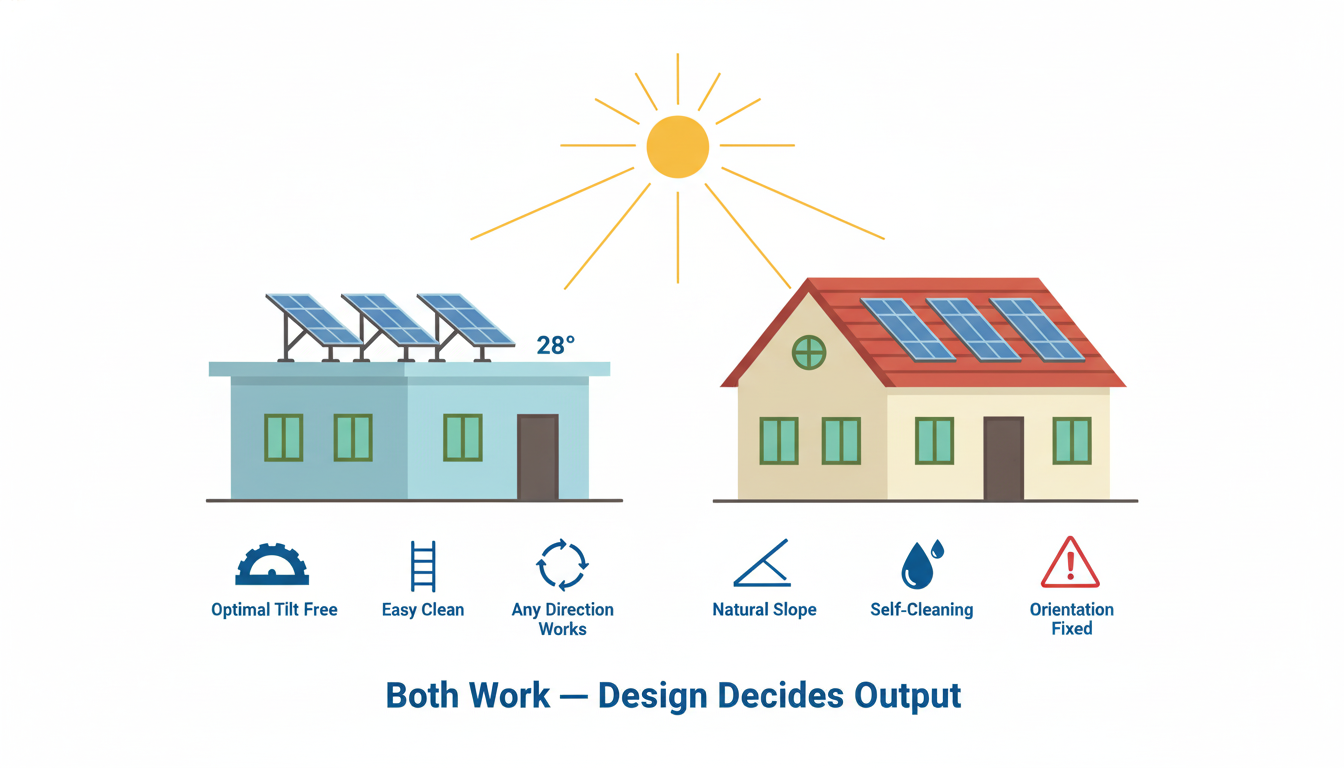
For Indian homeowners deciding between flat RCC terraces and slanted/tiled roofs, the honest answer is that neither automatically wins—what matters most is correct tilt angle, south-facing orientation, and shadow-free access to sunlight. Both roof types can deliver excellent output when designed properly, but they require very different installation approaches and carry distinct cost and maintenance implications.
How Roof Angle Affects Solar Output
Solar panel output is directly tied to how perpendicularly sunlight strikes the panel surface throughout the day. In India, since the country lies in the Northern Hemisphere, south-facing panels tilted at an angle close to the local latitude deliver the highest annual energy yield. For UP and North India cities like Noida, Delhi, and Lucknow (latitude ~25–28°N), the recommended tilt is 26–30 degrees to balance summer and winter performance.
Panels installed completely flat (0° tilt) can lose up to 10–14 percent generation compared to optimally tilted panels at the same location, as confirmed by PVWatts simulations.
Flat Roof: Flexibility Is the Biggest Advantage
Flat RCC terraces—the most common roof type in urban and semi-urban India—offer complete freedom in panel orientation and tilt, making them arguably ideal for solar. Installers use adjustable ballasted or bolt-down mounting frames to tilt panels at the correct latitude-based angle and orient them perfectly toward true south, irrespective of which direction the building faces.
Key advantages of flat roofs for solar include:
- Optimal angle control: Panels can be set at precisely 26–30° for North India, maximising annual yield regardless of building orientation.
- Easy access: Flat surfaces make installation safer and faster, reducing labour costs and simplifying future cleaning and maintenance.
- Flexible layout: Rows of panels can be spaced to avoid inter-row shading, using east-west or south-facing configurations depending on available roof area.
The main challenges are higher mounting costs (frames and ballast add material expense compared to flush-mounted pitched systems), potential drainage obstructions requiring careful design, and slightly more wind load planning.
Slanted (Pitched) Roof: Natural Tilt, Less Flexibility
Slanted roofs—common in South India, hill stations, and premium constructions—provide a natural tilt that, when south-facing, can closely match ideal solar angles without needing elevated mounting frames. A south-facing pitched roof in Chennai (tilt ~15°) or Pune (tilt ~20°) with minimal shading can deliver excellent output at lower structural mounting costs compared to flat-roof framing.
Key advantages of slanted roofs include:
- Lower mounting costs: Flush-mounted systems on pitched roofs use fewer structural components than elevated flat-roof frames.
- Natural drainage: Rain clears dust more effectively on sloped surfaces, reducing cleaning frequency.
- Better airflow: Pitched roofs typically allow better air circulation under panels, reducing heat buildup and keeping operating temperatures lower—important in India's summer heat.
The limitations are significant: if the pitched roof faces east, west, or north, output drops considerably and cannot be corrected without complex racking. Access for maintenance and cleaning is harder and potentially unsafe on steep slopes. Structural penetrations for mounting bolts also raise waterproofing concerns on tiled or metal roofs.
Optimal Tilt Angles for Indian Cities
| Region | Example Cities | Recommended Tilt |
|---|---|---|
| North India | Noida, Delhi, Lucknow | 26–30° |
| Central India | Bhopal, Nagpur | 20–25° |
| Western India | Mumbai, Pune | 18–22° |
| Southern India | Chennai, Bengaluru | 10–15° |
Which Gives Better Output: Flat or Slanted?
The answer depends entirely on orientation. A well-designed flat roof system with correct tilt and south-facing panels will outperform a poorly oriented pitched roof facing east or west. Conversely, a south-facing slanted roof at the right pitch in North India naturally performs at par or slightly better than a flat roof, with lower mounting costs and easier drainage.
For most Indian urban homes—which are predominantly flat RCC terraces with building-wide freedom in panel placement—flat roofs provide superior practical advantages: tilt control, orientation independence, and easier maintenance.
Cost and Maintenance Implications
Flat-roof mounting frames cost roughly 15–25 percent more than flush-mounted pitched systems for equivalent capacity due to structural framing materials. However, lower maintenance costs (easy access for cleaning) and the flexibility to extract optimal generation can offset this over a 25-year system life. Slanted roofs save on mounting costs upfront but may incur higher cleaning costs if slopes are steep and require professional access.
FAQs
Q1. Do flat roofs work well for solar in India?
A1. Yes, flat roofs are excellent for solar because installers can set the optimal tilt and south-facing orientation regardless of building direction.
Q2. What is the ideal solar panel tilt for Noida?
A2. For Noida and North India (latitude ~25–28°N), a south-facing tilt of 26–30 degrees delivers the best annual output.
Q3. Does a slanted roof give more output than a flat roof?
A3. A south-facing slanted roof at the right pitch performs similarly; a flat roof with adjustable mounting can match or exceed output from a poorly oriented pitched roof.
Q4. Can panels on a flat roof get dirty faster?
A4. Flat panels accumulate dust faster than sloped panels since gravity and rain do not clear debris as effectively, requiring more frequent cleaning.
Q5. Which roof type is better for large commercial solar systems?
A5. Flat roofs are preferred for commercial systems because they allow flexible, high-density panel layouts and reduce per-watt mounting costs at scale.

