Europe’s push for energy independence from imported fossil fuels has turned wind and solar into the backbone of its power system, with record output in 2025 and a structurally high build‑rate continuing into 2026.
2025 Milestone: Wind and Solar Beat Fossil Fuels
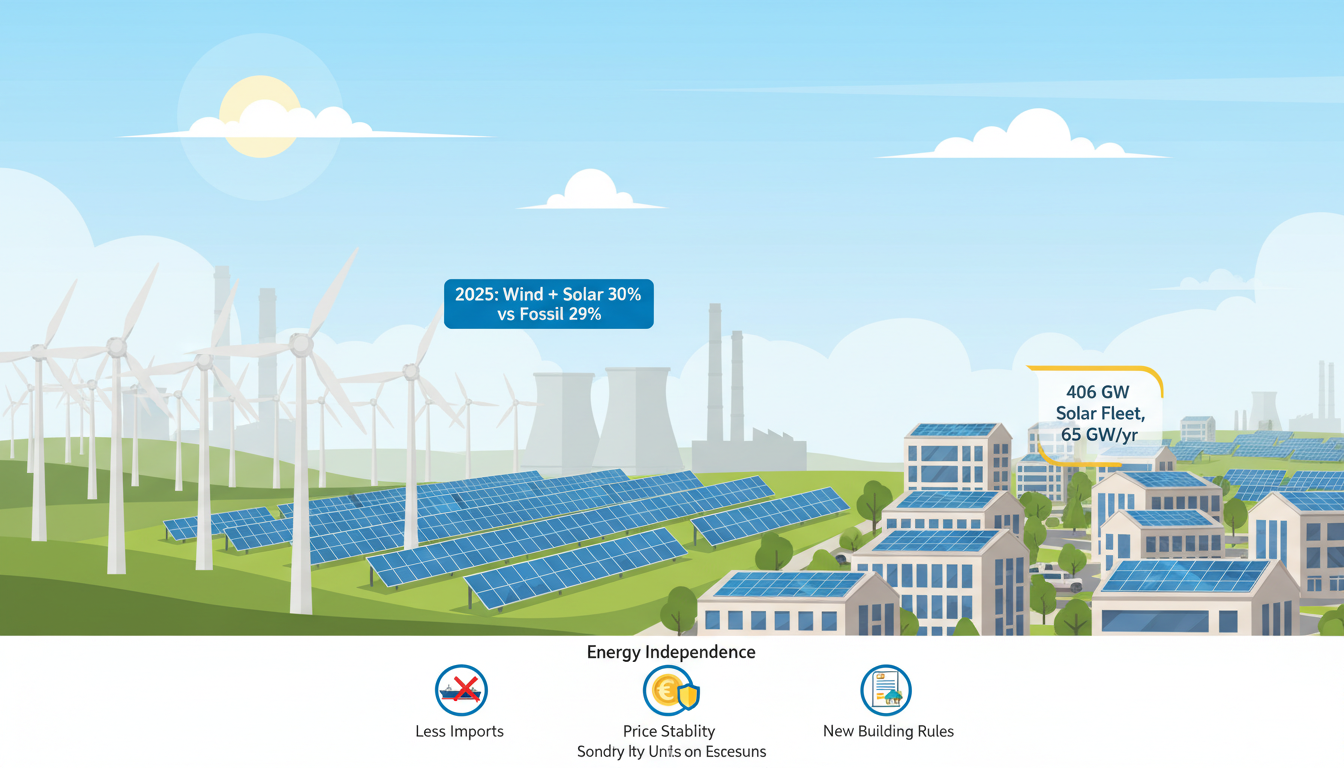
In 2025, wind and solar together generated more electricity in the EU than fossil fuels for the first time ever, supplying about 30% of the bloc’s power compared with 29% from coal, gas, and oil. Solar alone delivered a record 369 TWh—around 13% of EU electricity—after growing more than 20% year‑on‑year for the fourth year in a row, with several countries (Hungary, Cyprus, Greece, Spain, Netherlands) getting over one‑fifth of their power from solar.
Record Solar Fleet and High Wind Share
By the end of 2025, the EU’s installed solar PV capacity reached roughly 406 GW, surpassing its own 400 GW target set for 2025 under the EU Solar Energy Strategy. That year saw 65.1 GW of new solar added—slightly below 2024’s 65.6 GW, but still an exceptionally high level by historical standards. Wind contributed about 17% of EU electricity in 2025, remaining the second‑largest single source of power and producing more than gas despite slightly weaker wind conditions.
2026 Outlook: High Plateau, Not Collapse
SolarPower Europe’s EU Solar Market Outlook expects a temporary contraction in solar additions in 2026 and 2027 after the rapid 2022–2024 run‑up, before growth resumes toward the end of the decade. Even with this adjustment, Europe is forecast to keep adding tens of gigawatts of new solar per year, and total capacity is on track to climb from about 406 GW in 2025 toward roughly 718 GW by 2030 in the central scenario. Analysts frame 2026 as a “transition year,” where markets digest the recent surge, permitting and grid bottlenecks are addressed, and new policies (like mandated solar on new buildings under the revised Energy Performance of Buildings Directive from 2026) start to bite.
Energy Independence as the Core Driver
The EU’s wind–solar boom is tightly linked to energy‑security strategy following the gas price shock and supply disruption after Russia’s invasion of Ukraine. European institutions explicitly connect solar expansion to reduced fossil‑fuel imports and long‑term price stability, describing solar as a “shining star” of the clean transition due to its falling costs and deployment speed. Think tanks like Ember argue that to stay on a 1.5°C‑compatible and energy‑secure pathway, EU wind and solar additions will still need to roughly double from mid‑2020s levels by the late 2020s, even after the 2025 milestone.
FAQs
Q1. Did wind and solar really overtake fossil fuels in Europe?
Yes, in 2025 wind and solar supplied about 30% of EU electricity, versus 29% from fossil fuels, marking a historic first.
Q2. How much solar capacity does the EU have going into 2026?
The EU’s solar fleet reached around 406 GW by the end of 2025, slightly above its 400 GW target for that year.
Q3. Are EU solar installations still growing in 2026?
Installations remain high but are expected to dip below the 2024–2025 peak, before recovering later in the decade.
Q4. Why is Europe still pushing wind and solar if it already beat fossil fuels?
To strengthen energy independence, cut import exposure, and stay aligned with 2030 climate targets, the EU still needs faster wind–solar growth.
Q5. What new policies support solar from 2026 onward?
The revised buildings directive phases in requirements for solar readiness or installation on new and some existing buildings, supporting continued rooftop growth.

