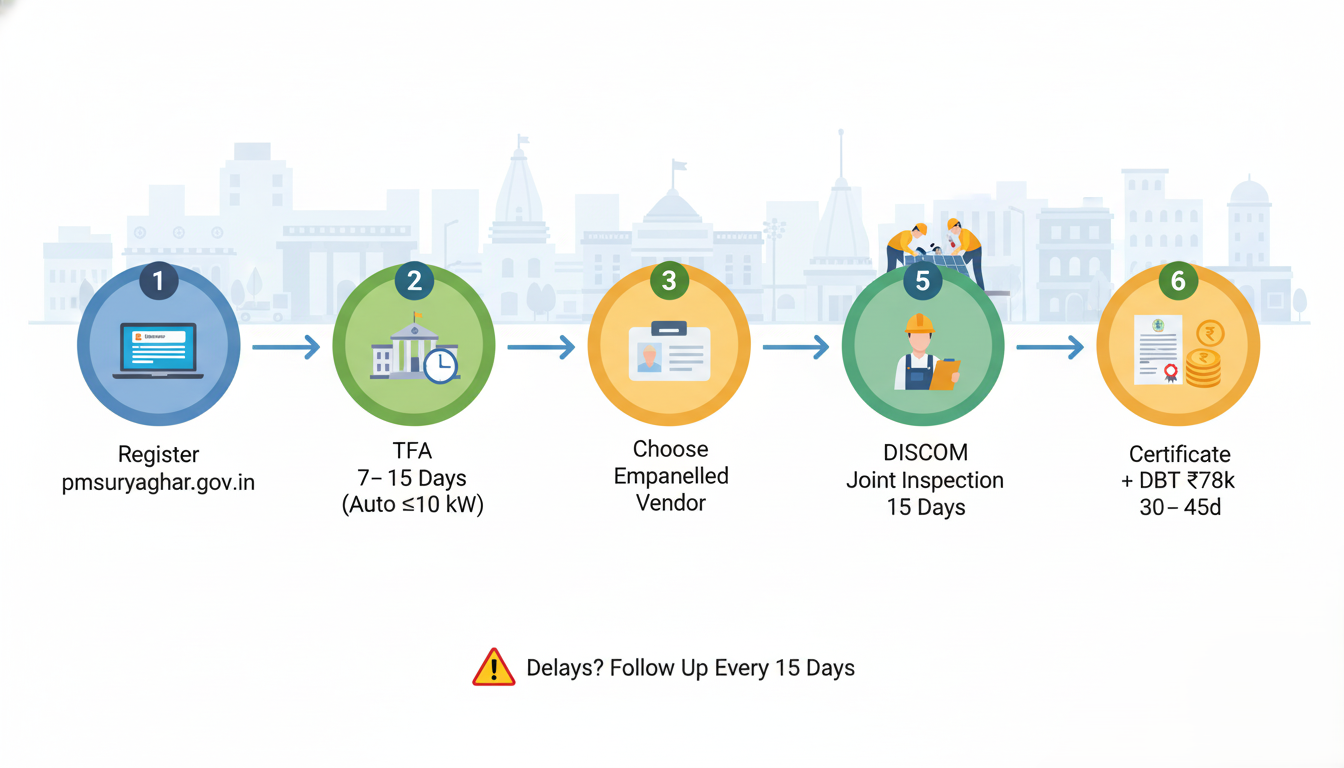
The DISCOM approval process is the backbone of every legitimate rooftop solar installation in Uttar Pradesh. Understanding each stage—from portal registration to net meter activation—helps homeowners avoid delays, stay subsidy-eligible, and get their systems generating as quickly as possible in 2026.
Which DISCOMs Operate in Uttar Pradesh?
Uttar Pradesh has five electricity distribution companies, each covering specific regions. PVVNL (Paschimanchal Vidyut Vitran Nigam) covers Western UP including Noida, Ghaziabad, Meerut, and Agra. DVVNL (Dakshinanchal) covers Agra, Mathura, and Bareilly. MVVNL (Madhyanchal) covers Lucknow, Kanpur, and surrounding districts. PUVVNL (Purvanchal) covers Varanasi, Gorakhpur, and eastern UP. KESCO serves Kanpur city specifically, and LESA covers Lucknow city.
All five DISCOMs are linked to the national PM Surya Ghar portal and process rooftop solar approvals through a unified framework governed by UPERC regulations and the UP Solar Energy Policy 2022.
Step 1: Register on the National Portal
Begin by visiting pmsuryaghar.gov.in and creating your consumer account. Select Uttar Pradesh as your state, choose your specific DISCOM from the dropdown, and enter your electricity consumer number from your latest bill along with your registered mobile number for OTP verification. After registration, log in and click "Apply for Rooftop Solar" to fill your application with personal details, address, proposed system capacity, and load requirements.
Step 2: Technical Feasibility Approval (TFA)
Your application moves to your local DISCOM's technical team, which assesses whether the distribution infrastructure—feeder capacity, transformer loading, and service line adequacy—can support your proposed solar system.
Under the Electricity (Rights of Consumers) Amendment Rules, 2024, the DISCOM must complete feasibility review within 15 days. If no response is given within this deadline, the system is deemed technically feasible and automatically approved. Crucially, systems up to 10 kW are fully exempt from the technical feasibility study under these rules, further accelerating residential approvals since most home systems fall within this range.
UP Solar Energy Policy 2022 mandates an even tighter timeline—DISCOM acknowledgment within 1 day and site verification plus technical feasibility within 7 days of application.
Step 3: Select an Empanelled Vendor
After receiving Technical Feasibility Approval, select a UPNEDA- or MNRE-empanelled vendor from the approved list on the portal or UPNEDA's website. Only installations by registered vendors qualify for PM Surya Ghar central subsidies and UPNEDA state support, making this a non-negotiable step. Your vendor will conduct a detailed site survey, prepare the solar system design, and handle net metering documentation on your behalf.
Step 4: Installation Within 90 Days
Once the vendor is confirmed and materials are procured, installation must be completed within 90 days of technical feasibility approval, as mandated by the UP Solar Energy Policy 2022. A standard residential installation of 1–10 kW typically takes 2–3 days of actual on-site work, including panel mounting, inverter installation, DC and AC wiring, earthing, and surge protection.
Your vendor submits a net metering application to the DISCOM alongside installation documentation, requesting replacement of your standard meter with a bidirectional net meter.
Step 5: DISCOM Joint Inspection and Meter Installation
After installation, the DISCOM conducts a mandatory joint inspection of your rooftop solar system to verify that it meets all technical standards—panel specifications, inverter type, earthing, AC and DC protection, and grid interconnection safety. This inspection ensures compliance with CEA regulations and UPERC guidelines before the system goes live.
Under the 2024 consumer amendment rules, the DISCOM must complete meter installation and system commissioning within 15 days of receiving the installation certificate from the consumer. Solar and net metering testing must be completed within 7 days from meter deposit under UP policy timelines. The full practical timeline from application to net meter activation typically runs 6–10 weeks, with KESCO and LESA (Lucknow city) generally faster at 15–30 days for feasibility.
Step 6: Commissioning Certificate and Subsidy Claim
Once the DISCOM completes inspection and installs the net meter, it issues a Commissioning Certificate—the most important document in your subsidy journey. Upload this certificate on the national portal along with your bank account details, cancelled cheque, and installation photos.
The central subsidy (CFA) of up to ₹78,000 is then processed by the fund-handling agency and transferred via Direct Benefit Transfer (DBT) to your Aadhaar-linked bank account within 30–45 days. UPNEDA's state subsidy follows shortly after through a separate disbursement process.
Key Timelines Summary for UP Homeowners
| Stage | Responsibility | Mandated Timeline |
|---|---|---|
| Application acknowledgment | DISCOM | 1 day |
| Technical feasibility (>10 kW) | DISCOM | 7–15 days |
| Systems up to 10 kW | Auto-approved | No study required |
| Installation | Vendor | Within 90 days |
| Joint inspection | DISCOM | 7–15 days after installation |
| Meter installation | DISCOM | 15 days after commissioning |
| Subsidy disbursement | GoI/UPNEDA | 30–45 days after upload |
What Can Delay Your Approval?
Common causes of delays include mismatches between Aadhaar, electricity bill, and bank account names, transformer capacity constraints in densely solar-saturated areas (DISCOMs can limit new connections to 75 percent of transformer capacity), non-ALMM-certified panels or non-empanelled vendor selections, and incomplete documentation uploads on the portal. Staying proactive—following up every 15 days with your DISCOM if approvals are pending—ensures you capture the mandated timelines and escalate if deadlines are missed.
FAQs
Q1. How long does DISCOM approval take for rooftop solar in UP?
A1. Systems up to 10 kW are auto-approved; for larger systems, feasibility must be completed in 7–15 days, with the full process (application to net meter) taking 6–10 weeks.
Q2. Do I need technical feasibility approval for a small home system?
A2. No, systems up to 10 kW are fully exempt from technical feasibility study requirements under the 2024 consumer amendment rules.
Q3. Which DISCOM covers Noida for rooftop solar approvals?
A3. PVVNL (Paschimanchal Vidyut Vitran Nigam) covers Noida and western UP for all rooftop solar approvals and net metering.
Q4. What happens if my DISCOM misses the approval deadline?
A4. Under the 2024 amendment rules, the system is deemed technically feasible and automatically approved if DISCOM doesn't respond within 15 days.
Q5. When is the commissioning certificate issued?
A5. The DISCOM issues it after joint inspection, and must complete meter installation within 15 days of receiving your installation certificate.

