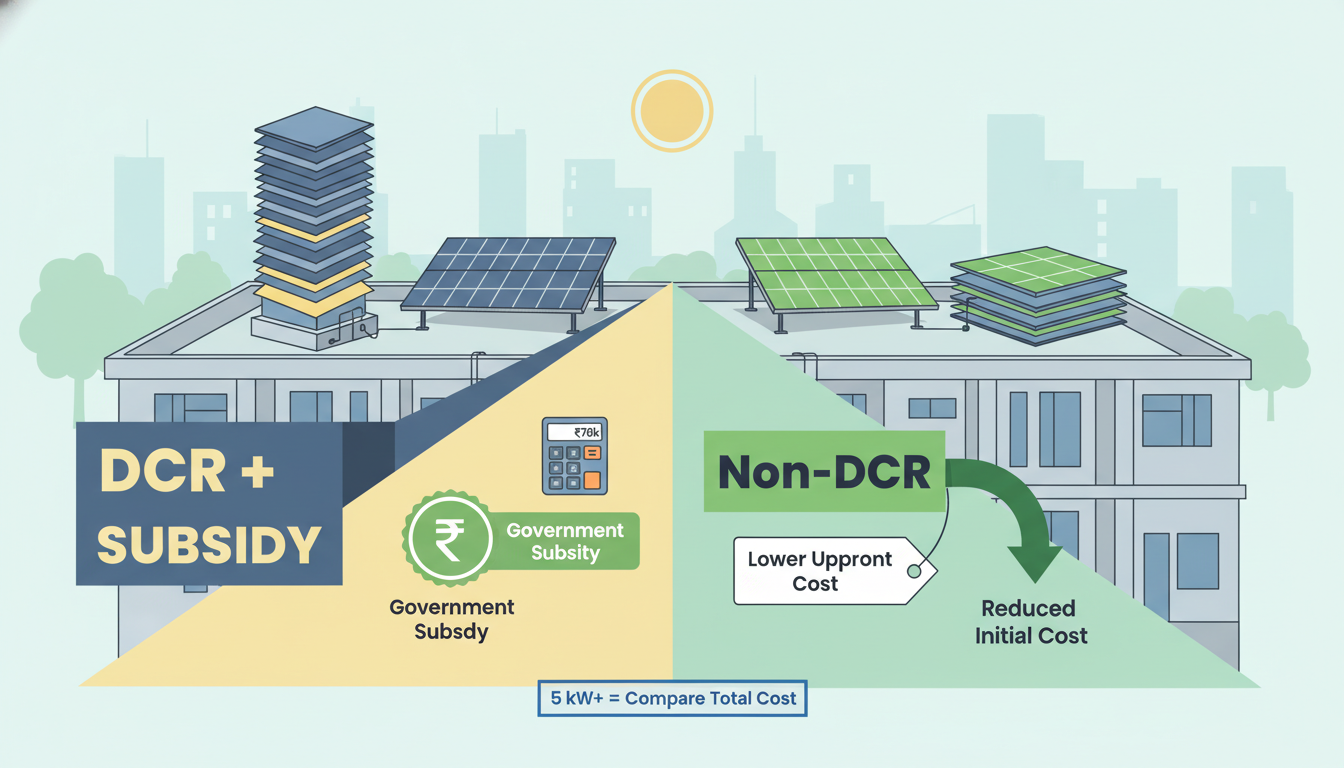
For a 5 kW or larger rooftop solar system in 2026, the subsidy route is not always the cheapest route. In many North India cases, especially for larger residential systems, non-DCR imported panels can deliver lower upfront cost and better long-term performance than subsidy-linked DCR panels.
The Core Trade-Off
DCR panels are the safer choice when the PM Surya Ghar subsidy is material relative to system cost, especially for smaller systems. Non-DCR panels become more attractive as system size rises, because the subsidy is capped while imported TOPCon and HJT modules often cost less per watt and perform better in hot climates.
MNRE's April 2026 portal update also makes the non-DCR path easier for subsidy-free consumers by allowing the "Give It Up" option without a DCR certificate, though that choice is irreversible once submitted.
Where The Math Changes
The subsidy under PM Surya Ghar is capped, so it matters far more for small systems than for larger ones. For a 3 kW rooftop system, the subsidy can be transformative; for a 10 kW system, it covers only a slice of total cost, while the non-DCR route can cut module cost enough to offset the subsidy gap.
| System size | Best fit | Why |
|---|---|---|
| Up to 3 kW | DCR + subsidy | Subsidy has the biggest impact on net cost. |
| 3–5 kW | Usually DCR + subsidy | Subsidy still matters, but premium non-DCR can narrow the gap. |
| 5 kW and above | Often non-DCR | Lower module cost and better performance can outweigh the capped subsidy. |
Why Non-DCR Often Wins
Non-DCR panels are typically imported TOPCon or HJT modules, which are generally more efficient and more heat-tolerant than older Mono PERC-based domestic options. In North India's summer conditions, that means less temperature loss, slower degradation, and higher lifetime output.
Recent industry guides and market listings also show that non-DCR TOPCon products are widely available in India in 2026, with lower per-watt pricing than domestic DCR options in many cases.
Policy Constraints
The key policy point is that DCR and subsidy eligibility are not the same thing as general installation eligibility. Consumers choosing the "Give It Up" route can avoid the DCR certificate step, but they must still comply with ALMM and other MNRE technical requirements.
The decision is also one-way: once you submit a non-DCR "Give It Up" application, you cannot later switch back and claim the subsidy. That makes it important to decide based on your system size, budget, and timeline before filing.
Practical Buyer Rule
If your goal is the lowest possible upfront cost on a small rooftop system, DCR with subsidy usually wins. If you are buying 5 kW or more, want better summer performance, or do not need the subsidy to make the project viable, non-DCR is often the better financial choice.
FAQs
Q1. Why do larger systems often choose non-DCR?
Because the PM Surya Ghar subsidy is capped, while non-DCR imported panels can be much cheaper per watt and offer better output in Indian heat.
Q2. Is non-DCR allowed under PM Surya Ghar?
Yes, if the consumer uses the "Give It Up" route and forgoes CFA, while still meeting ALMM and other MNRE requirements.
Q3. Can I claim subsidy later if I start with non-DCR?
No. MNRE says the non-DCR "Give It Up" path is irreversible once submitted.
Q4. Which option is better for a 10 kW system?
Non-DCR is often the better choice because the module price savings and better performance can exceed the value of the capped subsidy.
Q5. Are DCR panels always worse?
Not always. For smaller subsidy-linked systems, DCR can still be the cheaper net option once CFA is included.

