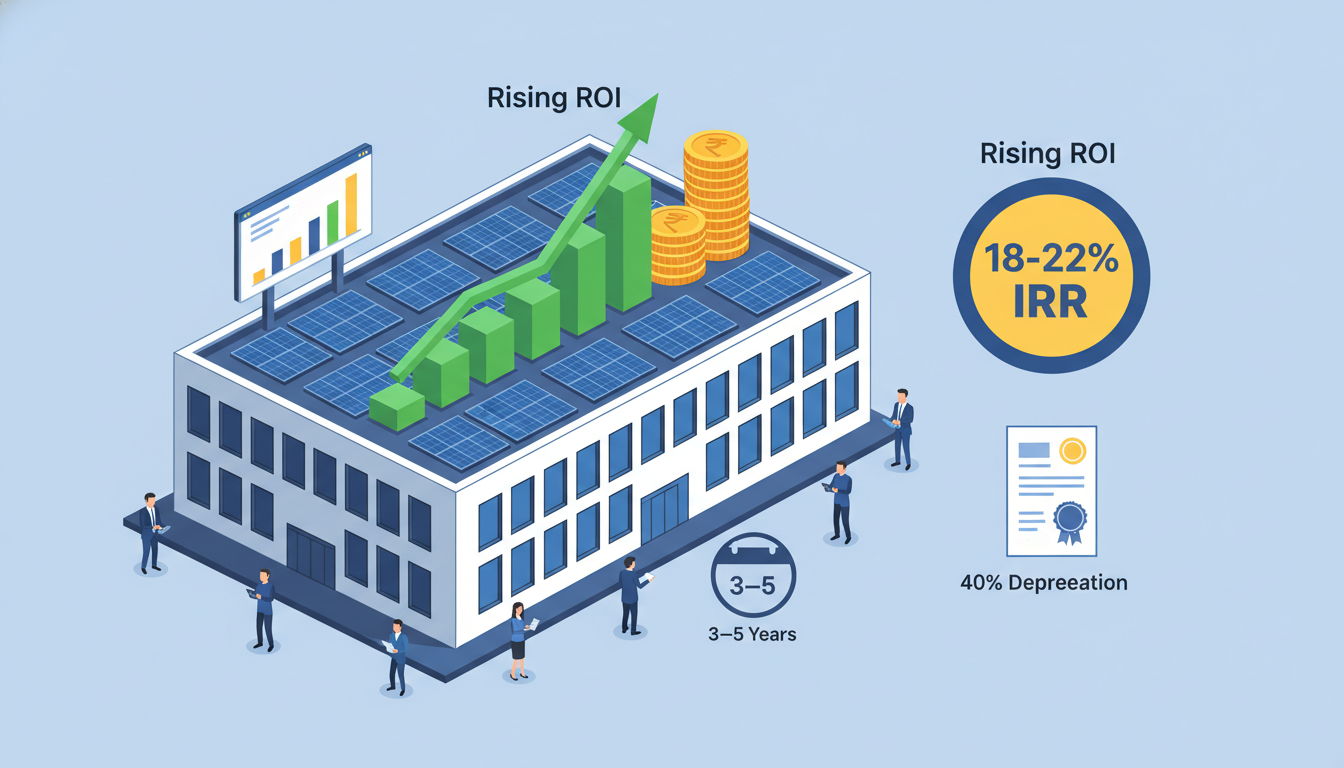
Solar is no longer just an energy decision for Indian businesses — it is increasingly a financial one. In 2026, commercial and industrial (C&I) organisations across India are treating rooftop and open-access solar as a high-yielding asset class, not merely a utility cost-saving measure. With IRRs of 18–22% and payback periods of 3–5 years, the numbers now rival many traditional capital investments.
Why C&I Solar Is Accelerating in India
The C&I sector accounts for roughly 50% of India's total energy consumption, with demand growing at approximately 10% CAGR annually. Two forces are making solar unavoidable for this segment: grid tariffs in some Indian states have risen sharply, while solar module costs have fallen nearly 30% in the last two years.The gap between what businesses pay for grid electricity and what solar costs them has never been wider — and it is widening further.
India's cumulative open-access solar capacity surpassed 30 GW by end of 2025, with 7.8 GW added in 2025 alone — the highest addition recorded in any calendar year. India's 2026 solar outlook projects 42.5 GW of new installations, with open-access PV becoming a business necessity rather than an optional strategy.
The Three Financing Models Businesses Must Understand
How a business structures its solar investment determines its financial outcome as much as the technology itself:
| Model | How It Works | Best For | Payback Period |
|---|---|---|---|
| CapEx (Own outright) | Business pays full upfront cost, owns asset, claims depreciation | Companies with capital, long-term focus | 3–5 years |
| OpEx / RESCO | Third party installs and owns; business pays per-unit tariff below grid rate | Businesses avoiding upfront spend | Immediate savings, no payback |
| PPA (Power Purchase Agreement) | Fixed long-term tariff contracted for 15–25 years; shields from grid price hikes | Large C&I consumers seeking price certainty | Immediate savings |
The CapEx model delivers the highest long-term ROI — typically 18–22% IRR over a 20–25 year system life — and allows full use of the 40% accelerated depreciation benefit in Year 1 under the Income Tax Act. The RESCO/OpEx model eliminates upfront investment entirely, making solar accessible even for businesses without capital allocation available, though long-term savings are lower than CapEx.
The 40% Accelerated Depreciation Advantage
For registered businesses and institutions, accelerated depreciation is the single most underutilised financial lever in Indian commercial solar. Under Section 32 of the Income Tax Act, businesses can claim 40% of the solar system's installed cost as depreciation in Year 1, directly reducing taxable profit and cutting the effective net cost of installation by 10–15% for a business in the 25–30% tax bracket.
For a 100 kW factory system costing ₹50 lakh, the 40% Year 1 depreciation creates a ₹20 lakh deduction — saving ₹6 lakh in tax for a business in the 30% bracket, giving a combined Year 1 benefit of ₹21 lakh when combined with electricity savings, and compressing the effective payback to approximately 2.4 years.
Open-Access Solar: The Large C&I Opportunity
Businesses consuming more than 500 kW — factories, IT parks, cold storage chains, large hospitals — can procure solar from off-site utility-scale plants through open-access arrangements, bypassing the DISCOM and purchasing renewable electricity directly from a generator at negotiated rates.
Open-access solar PPAs gaining traction in India offer tariffs of ₹3.5–5/unit — well below industrial grid tariffs of ₹8–12/unit in most states — locking in a 15–25 year price that hedges entirely against future tariff escalation. India added 7.8 GW of open-access solar in 2025, the highest annual addition on record, with Gujarat and Rajasthan contributing the largest shares.
ESG, Green Financing, and Export Competitiveness
The financial case for C&I solar extends well beyond electricity savings in 2026. Businesses with documented renewable energy procurement now access green loans and sustainability-linked bonds at 50–150 basis points below standard interest rates, improved ESG ratings that influence procurement decisions by multinational clients and foreign investors, and compliance with global sustainability frameworks including CDP, RE100, and TCFD.
Export market compliance is becoming equally pressing: European and US buyers are implementing Carbon Border Adjustment Mechanisms (CBAM) that will price carbon embedded in imports — Indian manufacturers using solar-generated electricity gain a measurable cost advantage over grid-powered competitors.
What North India Businesses Should Do in 2026
The window for locking in today's low module prices before June 2026's domestic cell mandate is narrowing. Profitable businesses should prioritise CapEx over RESCO to maximise IRR and capture the full 40% depreciation benefit in FY2026–27. For systems above 500 kW, open-access arrangements through UP's SLDC should be evaluated alongside rooftop options, given tariffs of ₹3.5–5/unit versus ₹8–12/unit grid rates.
FAQs
Q1. What is the typical ROI for commercial solar in India in 2026?
Businesses can expect an IRR of 18–22% over 20–25 years, with payback periods as short as 2–3 years when accelerated depreciation is factored in.
Q2. What is the 40% accelerated depreciation benefit for solar?
Under Section 32 of the Income Tax Act, businesses can write off 40% of the solar system cost in Year 1, reducing taxable income and cutting effective installation cost by 10–15% depending on tax bracket.
Q3. What is a RESCO model and is it available in Noida?
A RESCO installs solar at no upfront cost and charges a below-grid per-unit tariff; it is available across major UP cities through developers like Fourth Partner Energy and Amplus Solar.
Q4. What is open-access solar and who qualifies?
Businesses consuming 500 kW or more can procure solar from off-site generators at ₹3.5–5/unit through state grid open-access arrangements, bypassing DISCOM retail tariffs. India's cumulative open-access solar capacity crossed 30 GW by end of 2025.
Q5. How does solar help Indian exporters in 2026?
Solar-generated electricity reduces the carbon footprint of manufactured goods, providing a pricing advantage as Europe and the US implement Carbon Border Adjustment Mechanisms (CBAM) on high-emission imports.

