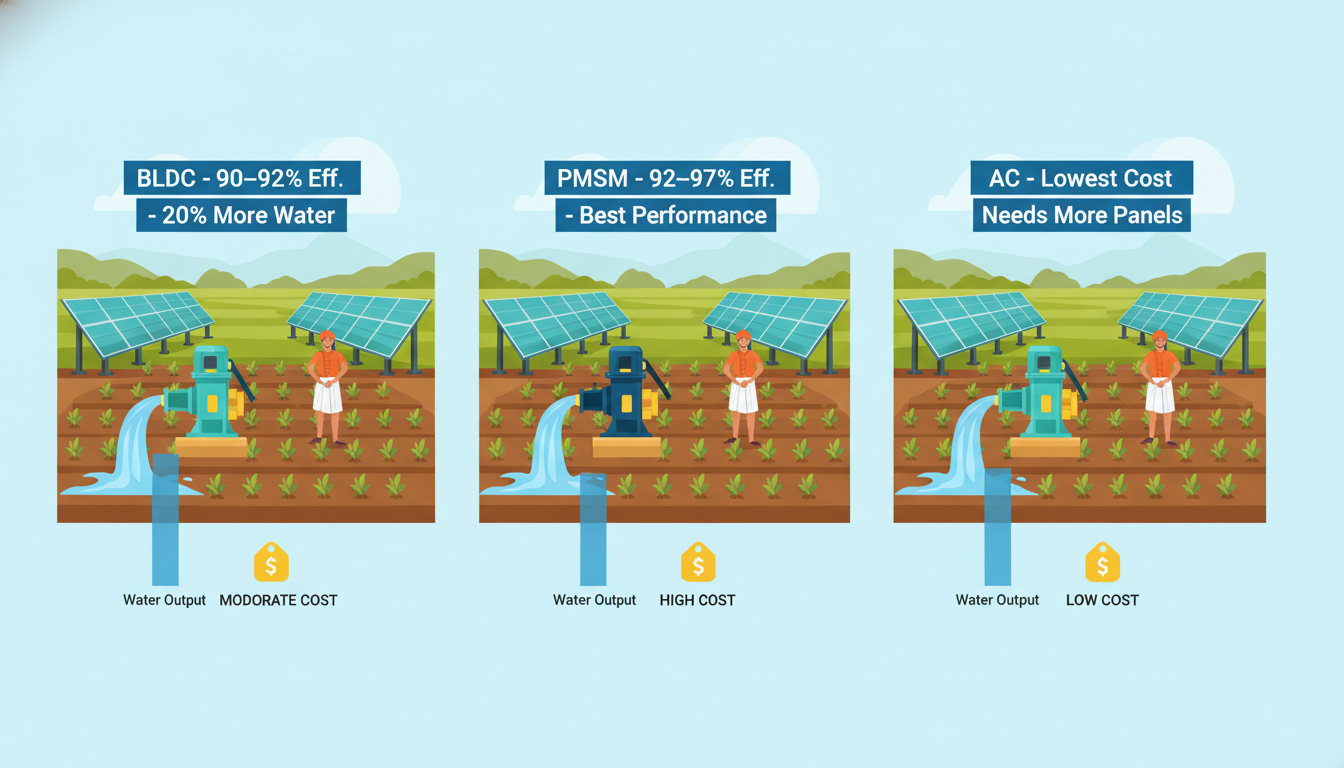
For most Indian farms, the shortest answer is this: BLDC solar pumps are the best all-round choice for small to medium farms, PMSM is the premium high-efficiency option, and AC solar pumps make sense mainly when upfront cost and local servicing matter more than efficiency.
Quick Verdict
If your farm is in a remote area, has limited panel space, or needs maximum water output from a small solar array, BLDC usually gives the best value. If you want the highest technical efficiency and smoother operation, PMSM is better, but it usually costs more and needs more advanced control electronics. AC pumps are simpler and easier to source locally, but they waste more solar energy and often need a bigger array for the same water output.
How The Three Compare
| Factor | BLDC Solar Pump | PMSM Solar Pump | AC Solar Pump |
|---|---|---|---|
| Efficiency | High, about 90–92% | Very high, about 92–97% | Lower, usually less efficient than DC options |
| Water output per solar panel | About 20% more than AC | Best when engineered well | Lowest for the same array size |
| Maintenance | Low | Low, but control is more complex | Higher and more conventional |
| Cost | Moderate | Highest | Lowest upfront |
| Best use | Farms with limited solar space | Premium performance setups | Budget-sensitive farms with local service support |
What BLDC Does Best
BLDC solar pumps are widely recommended for Indian agriculture because they convert solar power into pumping power efficiently across a wide operating range. The Department of Atomic Energy notes that BLDC pumps are attractive for agriculture because they offer about 92% efficiency, work over a wide voltage range, and can deliver about 20% more water output than an AC pump for the same solar panel capacity. This makes them especially useful in rural areas where sunshine is good but every panel matters.
BLDC is also practical when you want lower maintenance and strong day-to-day reliability. The brushless design avoids the mechanical wear of brushes, so service needs are reduced compared with older motor types, improving uptime and reducing long‑term operating costs.
Where PMSM Wins
PMSM is the performance leader if you are building a premium system and want the smoothest, highest-efficiency operation. General motor comparisons show PMSM typically delivers higher efficiency and smoother torque than BLDC, often reaching 92–97% efficiency, while BLDC is usually a bit lower. This makes PMSM attractive when you want the best possible conversion of solar energy into pumping output.
The trade‑off is that PMSM systems are more expensive and generally need more advanced control electronics and tuning. For many farms, the extra cost is hard to justify unless the installation is large, the water table is challenging, or available space for panels is tight.
Where AC Pumps Still Make Sense
AC solar pumps are the easiest to source and often the simplest to service locally. They can be a sensible choice if your priority is low upfront cost, existing electrical familiarity, or a local installer who already works with AC systems. In some cases, standardised AC‑pump tenders and spare‑parts ecosystems also favour AC.
The downside is lower solar utilisation. The DAE notes that solar BLDC pumps are a better fit for agriculture because AC pumps are less efficient and need a larger solar array to deliver similar water output. Over time, that can make AC systems costlier in real use even if the purchase price is lower.
Best Choice By Farm Type
- Small farms with limited roof or ground space: BLDC is usually the best balance of cost, water output, and efficiency.
- Large farms with demanding water needs and a bigger budget: PMSM is the premium choice if you want the highest performance.
- Budget‑conscious farms with easy access to local AC pump service: AC can work, but expect lower solar efficiency.
- Remote or unreliable‑grid areas: BLDC is often the most practical because it uses solar power efficiently without depending on grid quality.
PM‑KUSUM Scheme — Up to 60% Subsidy for Farmers!
Under the Government of India’s PM‑KUSUM scheme, eligible farmers can get up to 60% subsidy on solar water pump installations. The scheme supports standalone solar pumps and grid‑connected pump solarisation, and many states implement the program through DISCOMs and cooperative banks. [web:197][web:203] We assist with all documentation and approvals from start to finish.
FAQs
Q1. What is a solar water pump?
A solar water pump uses electricity from solar panels to pump water for irrigation without depending on diesel or grid power.
Q2. How does a solar pump help farmers?
It lowers irrigation costs, reduces fuel dependence, and gives farmers more predictable water access, improving crop reliability and net income. [web:202][web:203]
Q3. What types of motors are used in solar pumps?
Solar pumps commonly use BLDC, PMSM, or AC motors depending on the system design and application. [web:186][web:192]
Q4. Are solar pumps suitable for small farms?
Yes, solar pumps can be a practical option for small farms where irrigation cost and power reliability matter, especially under PM‑KUSUM support. [web:197][web:203]
Q5. What should farmers check before installing a solar pump?
They should check water depth, daily water requirement, panel size, pump capacity, and local subsidy support under PM‑KUSUM or state schemes. [web:202][web:207]

